Showing posts with label Commentary. Show all posts

Sunday, April 3, 2011

Masters and Slaves

Warning: This post is going to be harsh and offensive.  If you're disinterested in raw emotions coupled with stinging invectives, stop reading now.  If you can keep a dispassionate view and recognise this entry as what it is--an explosion of stressful feelings not directed at anyone in particular--then keep reading.

Who are the masters among us?

They seem to be those who manipulate and weasel their way into positions of power, thinking themselves suited for directing the lives of others.  They seem to be curdled souls tortured by unresolved psychological issues, who, in a sadistic twist, see fit to inflict their misery on others.  They seem to be the kinds of people who trip a macabre dance through the web of society, warts covering their eyes, and pestilential ideals burning the light of their days.  They seem to be the man or woman who thinks nothing of passing a regulation, bill, or expectation that indentures others to false pretenses, moral dissonance, and self-abasement.

Who are the slaves among us?

These passive souls lack the courage to block the passage of those who would purposefully dominate them.  They can't--sometimes won't-- see their own personal sovereignty as a human being, a member of the natural world.  They kowtow to the masters for fear of  being ruled too harshly; as if by cowering blindly under a self-proclaimed dominator their life will go easier for them; as if by denying the freedom inherent to their existence they will be able to gain the approval of those who seat themselves in places of authority.  They are willlingly blind, purposefully silent, self-abnegating, falsely humble, arrogantly immoral about their own self-worth, given to humourless self-deprecation, and easy to turn against their own kind.  They are sickly, weak, tepid personalities forced ever deeper into their own concentric shells by the force of their own untamed illusions and the violent machinations of those who presume the place of a master.

But the master doesn't need to be a maniacal fuckwit stamping about the earth in some sophisticated temper-tantrum; he doesn't have to be the person who gains his titular superiority by seeing how many people he can manipulate into bending over.  He can give those things up for a more reasonable, more mindful way of being.  He can change his negative self-limitations into positive self-sovereignty.

Similarly, the slave doesn't have to be a slave.  The alternative is blindingly simple: he can choose to be free.  He can shed his snake-oiled false humility, straighten his shoulders and recognise that he belongs: he belongs inherently to a class of creatures that have a unique freedom.  Why should anyone, let alone a slave, limit himself by his own preconceptions of useless servility?  Why serve something "greater" while touting the contradictory message that you are "unique"?  Doesn't that uniqueness assume the greater?  Doesn't being unique mean, definitionally, that you are greater?  What can be greater than the singular essence of your unique self?  There has never been a you before you, and there never will be another you after you: that makes you the "greatest," doesn't it?


If you fit the abject cowardliness of the modern slave, if you understand that your limitations are self-imposed (e.g., you can't do such-and-such because you haven't gone to university to get your letters), if you're the person who sneers at mainstream social impositions (e.g., getting an English degree to prove you can refer to others who write well), then bloody-well get off your ass and start doing it!  You don't need to modify your desires, your ambitions, your passions, to fit anyone else's expectations of how you should be.  Stop listening to the message of the masters, the slave-drivers.  See your uniqueness as your evidence of your sovereignty.

If the fact that no-one else is you doesn't convince you that you are, definitively, "the greatest," then you will always be the slave, the milquetoast personality that aspires to mediocrity, that lives under the bar as if it was a roof instead of raising it or removing it; if you cannot break free of the master-slave mentality that so predominates our cultural mechanisms, if you cannot declare your own personal freedom and sovereignty, then you are a slave and you will be ruled.  You will be ruled by the same self-limiting assholes that have made it profitable to thrive off of your weakness, your lack of creativity, your refusal to be a self-actuating personality.

Your uniqueness is proof of your greatness; it is the evidence of your personal sovereignty.  Stop feasting on the blandishments of mediocrity, of commonplace social expectations.  Start self-directing, self-dictating.  In essense, start being rationally selfish.  Or to put it less controversially, don't be afraid of self-referencing decisions: you are not required to sacrifice your personhood for the predeterminations of others who are no more fit to rule you than a camel is to play a guitar.  Be free.  Rule yourself.

Friday, March 25, 2011

38% of Americans Are Insane

What happened in Japan recently was terrible. The aftermath, and continued crisis is devastating. But is it "divine retribution," as one Japanese official put it? 38% of Americans seem to think so. So, with a well-deserved leap over the middle (the excluded one, that is), I have concluded that of those Americans polled, 38% of them are utterly insane.


What causes an earthquake is pretty basic: shifting of tectonic plates.  It is a natural occurence not needing divine prompting.  If God sees fit to dip his hand into the Sisyphean burden of pushing giant rocks, well then whatever.  Who's going to argue?  In the meanwhile, until we have some evidence of that reality, I'm content to take the operations of the planet on an evidentiary, naturalistic basis.  Because I'm not insane.

*Thank you Atheist Media Blog for this gem.

Friday, January 28, 2011

Big Words

I have been accused of using too many "big" words more than the total word-count of Marcel Proust's collected works.  That is, of course, an exaggeration.  Still, the number of times I have endured the crassness of being told "you use too many big words," or "why don't you just speak in English," or "would it hurt you to speak a little more simply" has become a source of silent irritation for me.

So now I'm going to write about it.  And I may just use sesquipedalian verbiage to spurn any familiar detractors.

To start, Ayn Rand wrote "words are a lens to focus one's mind."  If that is true, then the larger the lens the greater the focus.  Which really stands to reason since the proper use of a bigger word is not an easily accomplishable feat for the neophytic philologist.  Can I say that my use of larger words has always been clear, and well executed?  Heavens no!  I amassed an admirable storehouse of "big" words at a very young age simply by listening to the adults around me.  I didn't really know how to use those words properly, however, until I was more mature.

That's when I entered highschool.  In highschool, I was practically battered with small-worded accusations by friends and classmates alike for using words outside of their ken.  The same unthinking trend followed me through college and seminary, too. It was really quite demoralizing.

Who of us would arrange the courage in ourselves to accuse an excellent musician of being too quick at trills?  What right-minded individuals would upset themsevles for a gymnast's greater agility and balance?  It would seem to me that having a decent capacity for expression is no greater a crime than being able to run faster than others, or tickle out a frenzy of notes on the ivories with more finesse than the typical church pianist.

Now, I could go ahead and estimate the kind of distorted psychology that prompts such ill-reasoned attempts at censoring another's self-expression, but that would be too much of a meandering speculation for me to feel comfortable with.  Instead, what I've boiled things down to, in my own mind, is a more generous perspective. 

I think it's simply a matter of "jargon."  That is, people have environmentally prescribed jargon-sets that help them navigate their way through assumed common experiences.  And depending on the variety and intensity of those experiences, the amount and use of jargon changes.  But when faced with someone who can work with jargon across varied and diverse fields, communication can become a little intimidating.

So, what about jargon?

Well, everybody speaks it. Some more than others. It's especially rampant amongst chattering intellectuals, the back offices of medical centres, and the austere corridors of academia. But it happens on the street, too, where the “huddled masses” spin their cant in an ever-evolving dance of gritty descriptions and colourful metaphors.

When people speak their jargon on the streets we call it “slang.” When people pour out the lingo in cloistered meeting halls, sipping coffee and polishing their chins, we dignify it by labelling it “terminology.” And it may very well be that. But the only difference between the terminology of the person on the street, and the slang built in to certain fields of study is the environment in which they're used.

Who hasn't had the common experience of meeting-up with a co-worker at the coffee maker and spending the next several minutes listening intently to a subject that seems distant, foreign, even arcane? Who hasn't had the experience of being that person at the coffee maker percolating stories in strange terms while your co-worker squints on, earnestly attempting to relate to what you're saying?

It's something that the philosopher Ludwig Wittgenstein described very well when he wrote, “the limits of my language mean the limits of my world” (Tractatus Logico-Philosophicus, 1922). The words people use give an indication of the personal world of their experiences. A person used to living in the harsh backwoods of the Yukon wilderness may very well seem like a different creature to the savvy urbanite used to a steady diet of posh trends, and fashionable mannerisms. The point remains though: however they choose to talk about their experiences, they bring their worlds to each other by the very words they use.

So to argue by accusation that another uses too many "big" words can (as it did in my case) have the effect not only of diminishing one's own world by sneering at expansion, but demeaning another's world by snidely implying it is 'wrong' or 'difficult' because it is too big.  Having given some thought to this subject, it seems obvious to me that the best course of action when dealing with someone who has a demonstrably wide grasp of the English language (or any language, for that matter), would be to ask for definitions and explanations when fronted with a word one doesn't know.  The residuals may just be that your own world is given greater scope and colour, and that the other's world is appreciated and made more enjoyable.

Not a bad trade-off, really.  Wouldn't you agree?

Sunday, December 26, 2010

Normal

I don't like the word 'normal.'  It's one of the most overused, thoughtless, and empty words in the English vocabulary.  Mathematics defines normal as 90°.  After that, normal gets weird, dodgy, connotative and, well, abnormal.

You see, there is no normal in philosophy -- that strange application every one of us does to varying degrees in our lives.  Science really has no normal beyond importing the mathematical definition of the word.  Social sciences harbour freakish political mindsets abstracted from reality and imposed on fledgling minds; their 'normal' is the particular partisan persuasion of the institute teaching the social sciences.  And most often that persuasion happens to be in conflict with reality.

Economics doesn't have a 'normal'.  There's no 'normal' in environmental sciences.  There's no 'normal' in music.  Really, 'normal' just doesn't exist beyond being a sentiment that reinforces the guilt we're taught we should feel if we don't quite "fit in."  Add to the injury of that guilt the insult that mainstream media chats into our ears: be an individual.  So while it is that we should be concerned about 'fitting in', so that we don't appear abnormal, we should also be individuals (just like everyone else!), which is a message to stand in stark contrast to the status quo (i.e., the normal expectations around us).

Well, having explained my bafflement with the uncouth concept of normality, I will leave off this article with Ellen Goodman's famous quotation about what constitutes 'normal'.
Normal is getting dressed in clothes that you buy for work and driving through traffic in a car that you are still paying for - in order to get to the job you need to pay for the clothes and the car, and the house you leave vacant all day so you can afford to live in it.
Yeah. There's nothing like aspiring to mediocrity. How pathetic is that?

Wednesday, December 15, 2010

Richard Lynn: Disbelief and IQ

The Telegraph, a newspaper out of the UK, has put out an article detailing the findings of emeritus psychology professor Richard Lynn.  Lynn teaches out of Ulster University and has recently suggested that people with better than average IQs are less likely to believe in God.

Lynn's critics have labelled the findings "simplistic", and based on what I've read so far, I'd have to agree.

According to Lynn, the decline in religious affliation and belief in God dropped dramatically in the 20th century because people have become more intelligent.  A quick glance at the basic evolution of the human being, however, suggests that we may not have been as smart as our neanderthalic ancestors.  If that is true, then Lynn's findings are not only "simplistic", as his critics have charged, but inevitably wrong.

Neaderthals were highly religious (though not in an organised sense), even superstitious people, yet their overall cranial capacity suggests a larger brain, and therefore a possible better overall cerebral capability.  Mind you, as the documentary Battle of the Brains indicates, the jury's still out on whether a bigger brain means more potential capacity.  For some, smaller regions of the brain are more efficient than others who have larger regions, and visa versa.

So, while it is that neanderthals may have been smarter and people with better-than-average IQs may be less inclined to believe in God, there is no clear-cut link between belief in a set of propositions and the overall intellectual horsepower of a person's brain. 

And let's not fool ourselves into thinking that the world's major educational institutions are anything shy of nonreligious to begin with.  Hence people who flourish in academic settings are going to be much more highly influenced by the philosophical climate of the institutes they attend.  In our youth, we usually call that kind of exemplification "peer pressure", but somehow, when we peer into the upper-eschelons of academia the notion of that same "peer pressure" is overlooked, and people start exculpating themselves with unfounded excuses such as 'people are just smarter now.'  Nonsense!  People are able to access much more information now and, consequently, they are better equipped to meet the demands of reality face-on.

In any case, being better informed and having more ready access to information doesn't make a person smarter, and really doesn't show a link into disbelief.  The familiar logician's addage "correlation is not causation" is instructive here: while there may be an argument to suggest that readily available information can persuade people not to believe in God, that accessibility is not definitively the cause of a person's unbelief.  And let's not forget that there are many sincere, highly intelligent religious folk who have access to the same information that most other people do -- and they keep believing.

Wednesday, December 8, 2010

Arken Counter (It's a Copyright thing...)

World famous young earth creationist, Ken Ham -- of Answers In Genesis fame -- has stepped up and asked for donations of $24.5 million dollars to make an amusement park out of Noah's Ark.  Said distraction is, thus far, banally labelled, "Ark Encounter".

Yes, that's right, Mr. Ham is set to dazzle the world by recreating a big boat.  And he wants everyone else to pay for it.  Isn't that nice of him?

Well, in the spirit of charity, I decided to pop over to his blog and feed him a reflection.  However, because my response there was not immediately supportive but more probative, I have been placed in 'moderation' while others after me (because they're enthusiasts) have been permitted their breezy remarks.  Here is what I wrote:
If people are willing to donate multiple thousands of dollars to contribute a peg, plank, or beam would they also be willing to contribute the same kind of money to something more practical, like hosting a dinner for homeless people? Or, perhaps, renting an apartment for a struggling university student?

Why not do something more useful for God’s people? If the biblical stories are true, then we’ve already had an ark. Why do we need another one; especially one that’s just meant to impress viewers and serves essentially as vainglory?

And has anyone realised the contribution to deforestation this project entails?
I think my comments and questions are fair.  Why do we need what would essentially amount to a theme park attraction imaginatively abstracted from the pages of a 5000 year-old book?  And while the U.S. economy rides the waves of recession and depression, is it really essential to anchor otherwise useful funds into a boat-shaped playground?

And why build the bloody thing inland?  What kind of a stupid waste is it to have a giant, brand new boat sitting inland?  At least make the damn thing funtional!  Ooo!  I know: load on board the young earth creationists two-by-two and let them float away somewhere where we don't have to listen to their illiterate twaddle about the earth being 6000 years old. 

And on that point (about the earth being 6000 years old), I think Sam Harris summed it up best when he wrote in Letter To A Christian Nation, "This is, incidentally, about a thousand years after the Sumerians invented glue" (Vintage, paperback ed., p. x - xi).  But, if you're going to beat a dead horse, you may as well have glue as an end-goal.  Then maybe the young-earthers will have a little something-something to seal their planks and beams against the unfloods and inland breakers.

Monday, December 6, 2010

I Don't Believe In Hell

I don't believe in Hell.  I think the whole idea is contemptible nonsense.  If someone does believe in Hell, they must agree to some version of the following paradigm:
  1. God created everything, including people;
  2. People did stuff they shouldn't have and that made God upset;
  3. God set-up a place for people who make him miffed, and it is called 'Hell' (there's all sorts of unimaginably horrific torture that goes on without end in Hell);
  4. God wants to forgive everyone for not only doing irksome things themselves, but also for inheriting the irksomeness of the first people to ruffle God's feathers, as it were;
Conclusion: If you exist, you've been created sick, commanded to be well by asking forgiveness for sins you didn't commit but inherited, and if you don't ask forgiveness for those sins, then you'll suffer unmitigated torture forever and ever.  Amen.

Nope.  Sorry.  I don't buy it.  If the Christian message holds true, then Christ shouldered the burden of everyone else's sins.  That leaves everyone else standing on their own two feet, not taking on myriad generations of others misgivings.  That also means that if God created everyone sick, and demands that they be well, then there's no point in condemning them for the state he created them in.  Why bother creating anyone in the first place just to condemn them if they don't recognise their malady?

That is the message of a capricious and malevolent deity.

I think God's a little better than that.  If I can think of a more moral outcome to being a little spiritually daft, then I'm sure God must be slightly ahead of regular human morality, no?

Monday, June 7, 2010

Christendom: A House Divided

In Christian theology there are three main theories of the atonement:
  1. Jesus's crucifixion was to appease the wrath of God. God cannot countenance sin, and in his holiness must obliterate sin. Therefore Jesus, as a representative of the human race, was nailed to the cross as a sacrifice for all of humanity's sins -- past, present, and future. That is, Christ voluntarily assumed the sins of humanity on himself and died in place of the rest of humanity. This theory, crudely summarised as it is, is known as the penal substitutionary atonement.
  2. Christ came to conquer death by dying on the cross. Effectively, Christ acted as 'bait' to draw the devil away from humanity, and in so doing removed the devil's hold on humanity. It's a compliment to the words Christ uttered early in his ministry, "I have called you to be fishers of men." This theory is known as the "Ransom theory", or more recently the Christus Victor atonement.
  3. Jesus acted as the ultimate exemplar, and when we take heed of his sacrificial love our moral intentions are influenced christward. In short, Christ's life and sacrifice inclines our morals godward, thereby sanctifying us to be in his presence. This is known as the moral influence theory of atonement.
In the past few years, there has been a re-visitation of these theories. Theologians from different loyalties have bandied about their prefered vision of Christ's soteriological efforts. One book in particular has risen to the top of the academic list, Stricken by God? Nonviolent Identification and the Victory of Christ (2007). The book explores the various reasons for the necessity of certain theories, why the authors believe the theories they do, and how those theories are applied to everyday life.

It's editor and contributing author, Brad Jersak, admits his preference for the penal substitution theory. Nevertheless, in this article, professor and author Hans Boersma cautions against placing all one's philosophical capital in a single theory of the atonement. "The problem, said Boersma, is to take any one of these approaches and insist it is right and the others are wrong." This is sensible because prizing one theory exclusively excludes the beneficial points of the other theories.

The same holds true in other Christian academic applications. The novice theologian will place great import on a certain 'proof' of the existence of God. I had a fondness for the Ontological Argument back in my college days, but turned a snooty nose up at Kalam's version of the Cosmological Argument, for example. It wasn't until a good friend of mine, the late Hugh Hill (1958 - 2007) turned my head to the notion of a cumulative case for God's existence that I recognised it wasn't necessary to remain beholden to this-or-that particular 'proof' for the existence of God.

It's in that respect that I think it inane to cite a particular view of the atonement as the exclusively right view of Christ's death: it is the place of a novice or dilettante to throw one's lot in with a singular theory of the atonement.

To press this point a little further, it is instructive to note Boersma's final contribution to the article noted above:
Therefore, it is important to "bring humility to the table" and try to understand each other. We can "never say we have explained it all," said Boersma, since human language is "always inadequate to fully define the divine mystery."
True: human language cannot adequately define either the 'divine' or 'mystery'. Which is why I think Boersma would've done well to admit more by saying less. If Boersma had said in regards to the atonement that we can "never say we have explained it" and that human language is "always inadequate" we may have had a better rendering of the case. We would also have cause to graduate beyond the useless amateur quibblings of exclusivist atonement theory loyalties.

On a much grander scale, this is the same issue I have with Christian communities as a whole, if I can say that and make any sense. Let me explain. No-one is surprised when presented with the fact that Christianity is divided into many houses: Catholics, Lutherans, Methodists, Presbyterians, Anabaptists, Congregationalists, Pentecostals, Anglicans, the Emergent Church, the Eastern Orthodox, the Oriental Orthodox, ad-seemingly-infinitum.

Each grouping considers itself the model of unvarnished and inviolate orthodoxy alive today. I like to call this peculiarity of Christendom "local orthodoxy by attrition". That is, if it's said long enough and loud enough, eventually everyone will concede that "that's what so-and-so thinks about itself, so just let them have their illusions; we know that we're really the true orthodoxy." The same psychology, quite interestingly, holds true for liars, too: if they repeat their falsehoods long enough, they eventually believe them to be true.

Such self-exculpating tactics only reinforce what they're trying to avoid. That is, by denying the notion of orthodoxy to other Christian communities while remaining loyal to another one, a person can only be left with patronising concessions to faith-traditions not their own. This means that one believes their own particular faith-community to be the purest expression of biblical community above and beyond all others. This is a mark of superficiality, specious reasoning, and religious snobbery adopted by most Christians very quickly after conversion. Catholics and Lutherans, especially with their notion that they are the "one true church", are quite masterful at perpetuating such insidious sophistries.

It is much more sensible to regard the Christian communities of the world as part of a cumulative culture for Christ than a "house divided against itself", to borrow Christ's portentous words. But as long as Christians bark and bellow over which atonement theory is better and more right, which 'proof' is more accurate, which faith-tradition is purer, more orthodox, and therefore more fully in the faith -- as long as the house of Christianity remains divided against itself, we can reasonably speculate on Christ's conclusion that that house "will surely fall".

Tuesday, May 11, 2010

Belting Ford In The Head

A little over a week ago, I picked up a copy of the Institute for Creation Research (ICR) magazine called, Acts & Facts (v. 38, no. 5, May 2009). I was interested in finding out what is being said at the forefront of evangelical culture as regards evolution, that maniacally controversial hypothesis.

The opening article was a letter from the editor, Lawrence E. Ford, called “Time to Tighten Our Belt”. Ford's premise is that religion and politics have strayed from the conservatism of yesteryears. He disparages of the reality that in Texas, the 'buckle' of the Bible Belt, Christians have become more liberal. Ford identifies this drift away from religious and political conservatism as “battles raging against truth,” the antidote to which is to have a “commitment to truth – uncompromising biblical truth.”


And just what are these battles “raging against truth”? First, Ford states that Christians are accepting a diluted worldview that is a result of how scripture is read and interpreted. But that speculation stops with a deferal to Dr. Henry Morris III who has furnished Acts & Facts with an article dealing with the “Conflicts Between Text and Theology”. Morris's ½ page précis of classic Christian hermeneutics does nothing to validate Ford's deferal; it clarifies even less. What Morris's article does do, however, is admit that, “Interpretation places a filter on the words of Scripture so that one can 'rightly divide' (according to one's theology)” [italics mine].

So when Morris's article is taken alongside Ford's concern for the dilution of the biblical worldview in Christian culture today, we are left with two results: the interpretation of scripture is necessarily a free act done by individuals, which warrants liberalism in religion and politics; and, a justification to pick freely which side of the battle one will fight on. For if scriptural interpretation is a free act that every individual can do, then the interpretation that individual accepts may, or may not bolster the cause of evangelicals for or against evolution.

Second, Ford identifies the nature of 'science' as another battle. Says Ford, “'Science' is the critical word in this fight. Who has the right to define science and how it should be conducted and taught?” At this point, Ford unwittingly reinforces Sam Harris's crucial point that there is a “social disorder, a conversational disorder” between religionists and secularists. There will necessarily have to be disagreement on the scope and definition of certain fields of study like 'science' if the starting points of meaning are fundamentally opposed. Science does not start with religious assumptions; religion does not start with scientific assumptions. So saying, secularists are not beholden to religious definitions of science, nor are religionists bound to secularist definitions of science.

This really should come as no surprise to Ford, since he more than likely swears by a certain denominational creed. At the same time, he probably tips his hat in a warm and loving hypocritical nod to other Christian traditions not his own. Ford begins his religious definitions with the assumption that his current loyalties are correct and – in true missionary fashion – other's religious convictions are either incorrect, or somehow misguided. The point is that Ford has a different definition for his religion than others of the same faith. How much more the difference in definition between the religious and non-religious?

To see this as a battle, however, is really just blustering and propagandism. Ford has deliberately used the word 'battle' to muster the emotions of his religious cohorts and “spur [them] on to love and good deeds” (Heb. 10:24). By trumpetting out the battle-cry, as it were, Ford has bypassed the human intellect and relied solely on the reactionary emotionalism of others sympathetic to his cause. Ford does his readers a great disservice at this point by rendering conversation mute; who can levy definitions when they're too busy shouting to listen? How are secularists and religionists going to come to a place of agreement, even on such paltry items as definitions, if at least one of the two camps is stuffing the air with empty-headed emotionalism?

Nevertheless, Ford's blowhard rhetoric does put his point across, even if that point is blunt and ineffectual: Christians need to counter the claims of the non-religious scientists. There is no point of contact between creationists and evolutionists, and the sooner evolutionists admit their dunderheadedness the sooner we can get on with some real 'science'. You know, the kind of science that starts with a literal reading of Genesis, that doesn't blush at the notion of talking snakes, and willingly accepts that the earth only appears to be old, but it's actually young. The kind of science that betrays its own principles of verification by faithfully accepting a non-empirical god who currates the minutiae of the universe. The kind of science that disregards what is relentlessly provable (in this case, evolution) in favour of speculative gaps (i.e., intelligent design). The kind of science that is, in fact, religion.

Despite Ford's congenial triumphalism, his shameless plugs for ICR would read just as disingenuously if he were editing Skeptic Magazine. The fact of the matter is that Ford's whole premise rests on his presumption, nay, his faith that his religious perspectives are more science-minded than that of non-religious scientists. Because he can double-distill his scientific knowledge through his religion and his position as a spin-doctor/editor, he thinks he can afford the luxury of writing as though the irreligious are a pack of petulant bias-mongers out to stunt and stilt human growth. It does seem somewhat non compos mentus, however, to believe that evolutionists are out to harm or destroy the intellectual health of our species, when the whole point of their publications is to illuminate about the mechanisms of health and survival.

This point is lost on Ford, unfortunately. He's not interested in intellectual expansion, or socio-philosophical health and survival; he's interested in preserving his campy religious ideologies, receiving blind support from the emotionally volitile, and waging a war against evolutionists. He's interested in survival at any cost. Which is funny, overall, since that's exactly what the people he's fighting against are trying to teach, and what he's actively denying.

Tuesday, April 27, 2010

Responses to the New Atheism: Like It or Not

While reading literature on Atheism, I also fed myself a steady diet of books responding to the New Atheists. As in the last listing of books I posted, I will drop a picture of the dust-jacket on the left, state my 'Like' or 'Like It Not' in bold, sum the book up, and then give a small evaluation.

Like: It is reasonable to have faith. The Bible is a reasonable book that conveys reasonable truths that we can reasonably believe. Science has not disproven the Bible or discredited its moral teachings. There is no reason to accept the half-truths of the 'New Atheists', and every reason to re-visit the truths of biblical revelation.

Dinesh D'Sousa is clear, straightforward, and enjoyable to read. He meets the New Atheists on their own grounds, and uses their own sources to foil their attacks on religion, and on Christianity in particular. For the most part, his arguments are reasonable. However, just like the New Atheists, D'Souza often earmarks one side of the argument instead of presenting a wholistic look at the issue he is contending. To his credit, D'Souza is a wonderful rhetoritician and a persuasive writer. A certain lack of savvy follows from his inability to grasp the irony of arguing for a logical basis for faith, however. All-in-all though, D'Souza has produced a fine volume to add to the cultural conversation between religionists and anti-religionists.

Like It Not: A full-on counter-attack to Sam Harris' two landbreaking volumes 'The End of Faith' and 'Letter to a Christian Nation'. The worldview Harris presents in his infamous essays is utterly bankrupt, underscored by a vast ignorance, and nothing more than a charlatan's attempt at pedaling snake-oil metaphysics on a largely ignorant, unobservant culture.

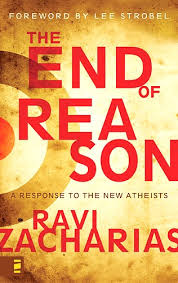
Ravi Zacharias
is a prolific writer, and a compelling speaker. A former atheist himself, Zacharias has built up a large ministry to people of differing faiths, and non-faiths alike. His principle aim in this book, it seems, is to dispell the accusations Sam Harris has set out against religious people in general, and Christians specifically. Unfortunately for Zacharias, his book never gets off the ground. It stinks of reactionary emoting, not reasoned, and considerate truth-seeking. Oftentimes, Zacharias moves toward a point but suddenly drops off, leaving the reader attempting to estimate his conclusion, and never returns to finish his idea. He accuses Harris of being fundamentalist in his outlook, but does nothing to soften or diminish Harris' equal accusation that American evangelicalism, and radical Islam are dangerously fundamentalist themselves. More to the point, Zacharias' book, being from a former atheist, falls ironically short of showing why atheism is an illegitimate worldview. One wonders why a scholar of Zacharias' renown and intimate understanding of atheism could not offer a coherent rebuttal of atheism in a book that expressly sets out to do so. Sadly, Zacharias' book is a poor, poor read, and will most likely find its way to a used book store in the near future with a small inscription detailing the impoverished material inside. Caveat emptor, indeed!

Like: The so-called New Atheists have saddled themselves with the same burden as literalist Christians: they're both fundamentalists. Calling for the end of faith and religion while trumpetting utopian overtures about human moral progress is bipolar thinking at best, and does nothing to promote civil dialogue between atheists and theists. What is needed is not an end to faith, not an end to religion, not a new injection of Enlightenment utopian ideologies but the courage to engage reason where it leads, and embrace religion where it benefits humankind.

Chris Hedges is a poignant writer. In fact, I found myself elated, disturbed, frightened, and relieved by Hedges's critical appraisal of the New Atheists. And as much as the New Atheists want to balk at the notion of their position being fundamentalist, when their writings are distilled to their lowest elements, they come out just as fundamentalist as any typical literalist Christian group. Be that as it may, however, Hedges does not give quarter to religiosity, but attacks it just as fiercely as neo-atheism. So, all-in-all, Hedges's book is a hard-hitting attack on unthinking faith-heads, just as much as it is an attack on unthinking unfaith-heads. In that respect, it is a fair and balanced read.

Like It Not: Faith and belief in God have come under attack. Skepticism is undermining believer's confidence in the Word of God. People would do well to understand exactly what is being said about their faith, and exactly how to respond to it so that Christian faith can continue to flourish and nurture not just the believers, but the skeptics, too.

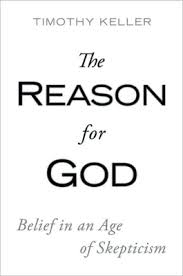
Timothy Keller
, while he has a wide-open and compassionate heart, comes across far too pedagogical, even cheaply condescending in this epistle. While some of the resources he has mined from are quite creative, they are dulled by the beige use of information he rambles out. More, while Keller seems to have a wide-ranging grasp of literature, philosophy, history, theology, and contemporary music, there is nothing in Keller's presentation of the Christian agenda that would give pause to even the most simple-minded literary atheist. His greatest strength in this book is that he can reduce large concepts into easily accessible and graspable ideas. Unfortunately, that same strength is also his weakness and his undoing: such simple presentations of Christian ideas leaves far too much opportunity to cut against the grain of his logic and undo his conclusions in ways that work against his evangelistic efforts.

Like: All religions have at their core one essential message: compassion. The expressions we use to convey that compassion are what are known as 'religion'. We can class religion into two distinct spheres: mythos (what is believed and practiced) and logos (what is reasoned and taught). To write-off religion on the basis that it doesn't conform to modern concepts of science and reason is to give-up a great swath of rich cultural heritage, learning, and useful metaphysics that not only inform our deepest human yearnings, but provide the substance that recent skeptics have been parasitically feeding from.

Karen Armstrong
has done the world a favour with this her latest book. Her writing is clear, sagely, incisive, profound, and beautifully informed. The occasional bursts of dry humour to break the weight of vast historical data are well-placed and drive the reader forward on to new insights and discoveries. After wading through thousands of years of philosophical and religious concepts, Armstrong finally cracks the whip on the New Atheists in her epilogue, giving them a solid scourging for their purposeful ignorance, but at the same time applying salves to their wounds by informing the reader that their perspectives help the religious ask necessary and important questions. There is no shortage of delight to be found in Armstrong's latest book, and I hope every serious student of religion and the philosophy of religion makes use of it to deepen their understandings of the strange creature homo religiosus.

Thursday, April 8, 2010

Sexrosanct

Mary's perpetual virginity. Ever a popular sentiment amongst Catholics, but one which seems at odds with reality.

Before I respond to the Catholic blither and blather of Mary's reproductive prudery, let's survey what it is Catholics believe on this count.

First, Mary was a virgin before, during, and after Jesus' birth. Second, after Jesus was born, Mary never engaged in sexual congress with her husband, Joseph. Third, Mary's perpetual virginity is distinct from the Immaculate Conception of Mary; the former refers to Mary's inconsummate marriage to Joseph, the latter to Mary's being born into the world without the stain of original sin. And finally, fourth, Mary's virginal status means that Jesus had no siblings. While being an obvious point, it is important to note number four because it provides a ready-steady defense for the use of the words "the brothers of Jesus" (Matt. 13:55; Mk. 6:3) to allegedly mean "cousins of Jesus".

If the gospel accounts of Jesus' arrival in this world are true, then there is no difficulty believing that Jesus' mother was a virgin before his birth, and during his birth. It was customary of Mary's time -- and is even sensibly encouraged today -- to abstain from sexual intercourse before marriage. Mary was betrothed (i.e., engaged, to use modern terminology) to Joseph when she became pregnant with Jesus, which, to Joseph, appeared as infidelity until he was reassured by an angel that all was well, and that Mary was pregnant by God's doing.

This in itself seems like a peculiar infidelity that God would impregnate another man's wife (I think Zeus was prone to the same misgivings, so no surprise a similar motif would show up in a Hellenistic culture). Leaving that aside, however, if it was that Mary was born without sin, why couldn't God simply have used Mary and Joseph's eventual union to create another sinless person, but this time one that also happened to be God? Afterall, he created people from dirt; I'm fairly certain he could funnel himself through an egg.

All of the above notwithstanding, unless Mary remained betrothed to Joseph forever after, that is, unless Mary and Joseph together decided they would never get married but just live together raising Jesus, it seems unlikely, even supremely implausible that Mary remained a virgin after Jesus' birth. Two things come to mind at this point:
  1. Mary and Joseph were religious Jews, and so, would not have lived together as a couple without being married; not unless they wanted to be stoned to death (recall the historical time and prevailing religion) for being considered fornicators;
  2. It has always been the sexual act that seals a marriage, that makes the covenantal bond between two people and the God/gods they are loyal to.
Given number two above, we would do well to keep in mind a tiny, niggling, insignificant triffle of a point: Catholics, by and large, believe that Scripture is God's inspired and inerrant word (set of writings) that is necessary and sufficient for understanding all matters of faith and morals. So let's just assume for a moment that Mary actually was married to Joseph, but the two remained celibate and thus preserved Mary's virginity. I think it would be fair to say that Joseph, unless he was one of the eunuchs Jesus later referred to (Matt. 19:11-12), might have "burned with passion" for Mary. And if Joseph had committed himself to live inconsummately with Mary, all-the-while lusting after her, it would seem that we have a couple of plausible contradictions:
  1. Mary and Joseph were witholding from each other, even knowing that at least one of them was desirous. This is a sin (see 1 Cor. 7:5) because it invites temptation into the marriage, and should only be done for a limited time; time enough for prayer and fasting, and then they were to enjoy marital bliss again.
  2. If it was sinful to withold from each other, then Mary's immaculate status is negated because she would've been sinning to enter a permanent, sexless marriage where one or both of the people involved would be sexually ungratified and desirous.
"Ah!" says the Catholic apologist, "you cannot hold Mary to a standard that God instituted through St. Paul approximately 35 years after Christ's death." Well, sure I can. And here's how: we're talking about what Catholics have always believed, not what they've ever known. There is not a single source in either scripture or tradition that can point to de facto proof that Mary never consummated her (eventual) marriage to Joseph. Thus what Catholics believe about Mary's permanent virginal status has no relationship with anything actually known. It is a supposition that lends Catholics a strange comfort, but seems at odds with reality when parsed by a slight flexing of practical logic.

There is a direct relationship between Mary's assumed lack of original sin, and the Catholic claim that she was/is ever a virgin. The doctrine of original sin found its first expressions in the writings of Irenaeus, bishop of Lyon, when he was arguing with Gnostics. But the champion of the doctrine of original sin, however, was Augustine, bishop of Hippo. Augustine reasoned that
original sin was both an act of foolishness (insipientia) and of pride and disobedience to God of Adam and Eve. He thought it was a most subtle job to discern what came first: self-centeredness or failure in seeing truth. The sin would not have taken place, if satan hadn't sown into their senses "the root of evil” (radix Mali).
But apparently Satan did plant a 'root of evil' into our nature such that our whole humanity -- that is, those things that constitute our unique human characteristics -- was forever wounded, depleted, broken. Characteristics such as our intelligence, affectations, sexual desires, and will were permanently enfeebled, according to Thomas Aquinas' rendering of Augustine. This enfeeblement is passed down, or transmitted, from Adam and Eve to all of humanity by way of concupiscence; that is, desire. The next logical step from desire being the transmitter of human enfeeblement is to suggest that the sexual reproductive act (the only way new people are made) is the purveyor of original sin.

This in itself does not make the sexual act wrong in Catholic theology. However, because Mary was to be the bearer of God himself, there could be no taint of sin in her. Hence Mary's parents' copulation, somehow, didn't transmit a wounded nature to Mary (how convenient, yet, sadly, entirely presumptuous). Mary was, it is supposed in Catholicism, therefore perfect in her human nature. Thus for Mary to engage in coitus with Joseph would imply the possible transmission of human sinfulness to any offspring copulating may produce. Since God had housed himself in Mary's womb, any post-Jesus children would be (conspicuously) bad, because apparently God and people shouldn't intermingle -- which brings up a whole other set of issues. For example, a smattering of gnosticism. But I digress...

Mary was above all base nonsense such as human sexuality; that seems to be the implication. In her perfection (lack of sin), she would not debase herself with the thrusts and stilted grunts of her imperfect husband. Never! The connection is clear: human woundedness is continued through sexual reproduction, which is beneath perfect people like Mary, so she abstained from conjugal relations with Joseph, who in turn probably experienced unbridled sexual frustration and was, due to an attrition of sorts, consigned to masturbation (which is also a sin in Catholicism). That is, unless by way of physical proximity to Mary, Joseph was able to master his sexual urges and content himself with a faux marriage; an unlikely possibility given the matrimonial customs of the time.

Before moving on to my last point, I will review, in short, the gist of my first three points:

  1. Mary would not have lived in a false marriage arrangement because this would implicate Mary and Joseph on the grounds of sexual sin: the surrounding community would've viewed a couple living together, and having a child together out of wedlock, as fornication.
  2. Mary's blameless and perfect nature would be blatantly stained by purposefully, and knowingly entering into a sexless marriage where her weaker, imperfect husband, Joseph, would burn after her with lust; i.e., Mary would've purposefully been tempting Joseph to sin.
  3. Mary's ever-virgin status, when distilled to its constituent elements, constitutes a form of gnosticism: she could not have copulated with one who bears the stain of original sin because her womb held the son of God; the perfection of God and Mary could not intermingle with the imperfection of a man.
These three criticisms give credit to the more sensible notion that Mary probably enjoyed her marriage as fully as any healthy married pair should. They also lend strength to the argument that Jesus most likely had brothers that were not simply 'cousins', but flesh-and-blood brothers. It is argued that when the Greek word adelphoi (brothers) was written into Scripture, it wasn't with the intention to convey a direct statement about the status of James, Joseph, Simon, and Judas being related to Jesus (Matt. 13:55; Mk. 6:3). Heavens, no! Why keep things simple? Instead, concoct a story that they're all just 'cousins', or half-brothers from a previous relationship Joseph enjoyed. This is a blatant violation of Occam's principle of parsimony, and highlights the useless convolutions Catholics are willing to accept in order to hold in high regard a dogma that has no foothold in reality.

And this, in itself, begs an obvious question. If it is true that Joseph had enjoyed a previous marriage, and then entered into a marriage with Mary, why would he want to give up one of the specific pleasures marriage allows: sex? Unless it can be argued from silence -- as assuredly Joseph's possible previous marriage is an argumentum ex silentio -- that Joseph was done with coitus funness when he set his eyes on Mary, there's nothing to support the notion that Joseph would willingly enter into a sexless marriage. At the same time, to give credit where it's due, there's nothing to support the notion that Joseph would not enter into a sexless marriage. In either case, we have absolutely no evidence at all to conclude on the virginal status of Mary, and Joseph's willingness or not to entertain an inconsummate marriage.

In conclusion, I think that the notion of Mary's perpetual virginity is purely a fabrication. Yes, many people have believed it for a good long time. However, the duration of a belief is no argument for its validity. Many people believed that the earth was flat for quite some time, but that is clearly not the case. From the reasons given by the Catholic church for Mary's eternal virginity, I have reflected some practical conclusions that show the weaknesses in the expectation that Mary was inconsummate in her marriage to Joseph. I could go on drawing further conclusions from the beliefs set out by Catholics, but it seems sufficient to say that Mary's constant virginity is a proposition based in silence, that when examined in a little detail becomes self-contradictory, disregards Occam's razor, highlights Catholic antisexualism, and therefore has no basis in reality.

Tuesday, March 30, 2010

Like It or Not: Reflections On Skeptical Literature P. 2

As in Part 1, there will be a picture of the book cover on the left, followed by Like It or Like It Not, a summary, and finally, a small evaluation.

Like: Religion is a pervasive poison that undermines and corrupts everything it takes part in. From the anti-intellectual fundamentalist to the highbrow theologian, the influence of religion is expressed in bankrupt notions of faith, false notions of our origins, unnecessary strictures on our human condition, hostility toward free inquiry, and by pre-disposing people toward violence and unthinking submisison to self-assumed authorities.

Christopher Hitchens has grown on me. I will admit that I found his eloquence and wit arrogant at first, but grew to understand that his concerns and expressions are genuine, sincere, and often quite valid. This is not to say that Hitchens' critical appraisal of religion is, shall we say, gospel, but he is more often right about his observations than not. I have been disapproving of Hitchens in the past on this blog, but as I stated above, I've grown fond of him. god is not Great is a poignant reflection on the intersection of religio-political realities that, I think, every thorough-going Christian would benefit from reading, and re-reading.

Like: Based off of Thomas Hardy's poem of the same name, God's Funeral is a striking exposé of the decline of faith in the Western world. By the time the 19th century had rolled around many, if not most of Europe's leading intellectuals had discarded traditional Christianity. Why? A.N. Wilson explores the causes of disbelief by investigating the lives of Europe's luminaries such as Hume, Carlyle, Mill, Hegel, Gibbon, et al.

Wils
on is rigorous in his scholarship, and gives a first-rank account of the dwindling life of faith in Western nations. I found myself drawn in by Wilson's avuncular tone and subtle humour. This book is not easily accessible to the non-academic -- in fact, it might prove rather dull for such a person -- but it is invaluable to the serious student of religious history.

Like: Michel Onfray presents an incindiary account of religious extremism, the rise of fundamentalism around the world, and the necessity of atheism as a reasonable antidote to religiosity. Humanity's health, happiness, and welfare depends on our willingness to reject religious extremism, and accept atheism.

I was a little apprehensive at first with this slim essay given that it's original title was Atheist Manifesto, a title that sounded more political than philosophical. However, after a few pages, I was enthralled. Onfray's criticisms of religious fundamentalism are at once shocking and necessary; humorous and poignant; incisive and well-rounded. His pace is fast, unforgiving, and tough-minded. In particular, I enjoyed Onfray's post-modern style; a nice contrast to the soothing eloquence of typical brit-lit (british literature) I typically gobble up.

Like: Traditional answers to the problem of suffering and the existence of an omni-benevolent God fail. Judeo-Christian attempts to wrestle with theodicy are a noble, but otherwise failed enterprise. Suffering works against the notion of a good God, and the Holy Bible does nothing to ameliorate the dilemma of continued suffering and the simultaneous existence of a personal, loving God.

Bart Ehrman is not a difficult read. This is not to say that he is less penetrating in his observations; he is simply more personal, given to less arid prose in this volume. I'm sure this is due in large part to his personal encounters with his subject material: evil and suffering co-existing with a supposedly good God. At the same time, his scholarship is difficult to argue with, and his logic reasonable (though, I must admit, not air-tight). I think this volume would be perfect as an introductory level study into the seeming disparity between raw reality and Judeo-Christian claims about God's benificent nature.

Like: A compendium of some of the most controversial, most insightful essays, poems, and declarations against the existence of gods/God, and the continuance of religion.

Christopher Hitchens has accomplished an excellent work in this book of secular treatises. There isn't a page where a serious reader cannot turn and find some kind of hard-hitting logic, or poignant but witty rejoinder to the typical ideologies enshrouded in religious thought. More, writers from many different genres, scholarly fields, and artistic disciplines contribute highly intelligent accounts of their personal, and sometimes scientific reasons for disbelief. Certainly, if a person wishes to have an account of life, reality, and sundry other things, but from the perspective of the anti-religious, then this book is perfect.

Saturday, March 20, 2010

Like It Or Not: Reflections on Skeptical Literature P. 1

As readers of my blog, you already know that I've been digging through a host of atheist literature this past year-and-a-bit. A workplace colleague of mine is convinced my decision to undertake atheist writings is Freudian: I'm reading their writings because I'm subconsciously looking to change my mind, alter my views on religion, or something to that effect. That could be the case, I'll admit, but unless that motivation graduates from the subconscious to the conscious, I will continue on not knowing if it's actually the case.

I will say this, though: I ventured into Atheist-land because I (consciously) wanted to research the reasons people reject supernaturalism and religion. I wanted to harvest from their writings a working knowledge of their philosophical and pragmatic decisions to be disbelievers, doubters, freethinkers, skeptics, even anti-theists.

Here is a small review of the books I read. I will classify each book beginning with Like or Like It Not. I will then sum the book up in italics, and follow-up with a small commentary.

Like It Not: The notion of 'god' and the faith that people claim are bad memes (culturally assumed bits of information and meaning passed down in an imitational evolutionary fashion; much the same as genes, but non-physical). Faith is a virus, and God is the delusional state of mind the faith-virus brings about.

Dawkins, in my opinion, is the least capable of the popular atheists. He is philosophically shallow, intellectually sophmoric, and unnecessarily aggressive. His summations of classical theistic arguments for God are simple-minded and, for the most part, the product of long hours playing in the straw. I agree with David Berlinski, who he called Dawkins out as a "crappy philosopher", and with fellow atheist philosopher Michael Ruse who expressed that Dawkins is "brazen in his ignorance of philosophy and theology", and "a man truly out of his depth."

Dawkins is a very good writer, to be sure, but style does not win-out over content when dealing with challenging philosophical issues. One simply cannot afford to throw away valuable insight for winning prose unless one intends to write sophistry. Still, I'd like to give Dawkins the benefit of the doubt that he wrote The God Delusion with the desire to be more than simply a literary snake-oil salseman.

The one redeeming quality Dawkins' book presents is that it provides a great deal of working material for the closet logician. It would be a great book for a Philosophy 101 class to play "spot the logical flaw".

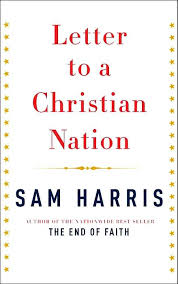
Like: A sweeping narrative about the dangers of setting aside reason for religious claims. Harris examines the extreme ends of religious fundamentalism (particularly in Islam), and by association the culpability of moderate faith expressions, and builds a case for why religion itself is a vehicle for destruction, and moral regression.

Harris is eloquent, straightforward, and unmistakeably angry in this polemic against fundamentalist religions. His position that religion spits in the face of reason is backed by clear quotes from historical religious leaders, such as Martin Luther who averred that "Reason should be destroyed in all Christians." This is an unacceptable proposition for Harris, who, as I'm sure you've already figured out, argues that reason should take its primacy in people over above religion so that we can get on with practical progress in areas like physical and emotional health, social solidarity, and peace.

As an aside, Ravi Zacharias' paltry return, The End of Reason, is a horrific attempt at countering Harris' anti-religious, anti-faith stance. I don't recommend it at all. Save your money, and your time.

Like: A personal, and upset letter to fundamentalist Christians questioning the reasons, motives, and political interests of belief in America today.

Harris' second anti-religious volume, Letter to a Christian Nation, is a much easier read than his first installment, The End of Faith. It's something more akin to a Socratic interrogation, and hinges on hard-hitting, utilitarian premises expressed in rhetorical questions that reduce religious doctrines to the absurd. Still, it's uncompromising stance, while being admirable in itself, will not serve to edge fundamentalists toward reason, but, because of the book's harsh polemics, will more than likely drive the militant believer further into his/her camp.

Like It Not: Armstrong examines the origins of Judeo-Christian scripture, its use in early Jewish and Christian communities, the varying hermeneutic traditions, and the ways in which people (clergy and laity) applied holy writ to the formation of doctrine, and their personal lives. This highly detailed account forces the conclusion that no single religious group has the ultimately correct interpretation of scripture.

I had a hard time putting this book in the 'like it not' category because there were many highly enjoyable moments throughout its pages. I think it fair to say, however, that the book requires the reader come to it with a wide base of knowledge already in place. In my case, I already have that base in place, but I found myself glazing over when Armstrong meandered into obscure references, and long drawn-out examinations of traditions that may have had an indirect impact on the composition of sacred scripture. While marginally relevant, those meandering and drawn-out sections seemed, for the most part, like non sequiturs. I'm sure if I re-read the book, I could see how those sections fit the overall scope of the Bible's composition, but on first read, the book really ought to be apparent enough that I don't have to go back and map my way through.

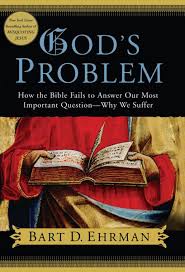
Like: As any good theologian should, Bart Ehrman closely examines the issue of suffering, the continuance of suffering, and the supposed 'goodness' of God. In particular, Ehrman walks through scripture showing how the 'good book' does not answer to the reality of suffering and evil in this world.

At times, it seems like Ehrman plays fast and loose with logic on the issue of suffering. Overall, however, I enjoyed Ehrman's blending of personal experience, theological insight, and philosophical acumen. An ex-Christian, now agnostic, Ehrman doesn't take any shortcuts when dealing with the common explanations for why God would allow suffering. He is courteous, but exacting, and he simply doesn't think that Judeo-Christian scripture gives any reasonable justification for why suffering exists alongside a supposedly 'good' God. Ehrman's examination of the issue of suffering and the existence of a personal, good God goes a long way in showing that we either don't really know what we're talking about when we talk about God, or that suffering co-existing with the goodness of God are undeniably problematic, even contradictory.

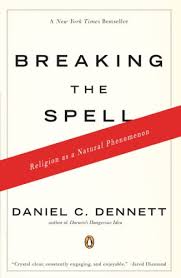
Like: Religion is a natural phenomenon arising out of pre-scientific needs to explain events and realities we do not understand (e.g., death). Our gradual gains in understanding are met with an ever-developing mythology about divinity, the afterlife, and seeming miracles, until, at some point, our common notions of ancestor-worship blended into tribal gods, and finally the monotheistic religions. Continuing to hold to outdated, pre-scientific notions of divinity should be met with evidence-based dialogue that emphasizes naturalistic explanations for the world we occupy.

Daniel Dennet is given to wandering prose. He is often not very succinct, and seems to want to lull people into agreeance with him by presenting the options available for discussion and then sharply cutting off the options he doesn't wish to discuss. Despite this, however, he is sincere and not as inclined to cudgel the religious as, say, Dawkins.

His tone is grandfatherly and comfortable, and he is a wealth of interesting ideas that synthesize evolutionary notions with religious inclinations. This is not to say that he advocates a blending of naturalism with religion, but that he can envision plausible ways in which the evolution of the human species necessitated the development of religion, and how our continuing evolution as a species might mean that we now need to purge ourselves of religion. Of all the skeptical literature I've read this past while, I will likely re-read Dennet's book, if only for its conversational rather than adversarial tone.

Like It Not: The universe appears just as we should expect it would if there were not God. The physical sciences demonstrate that a deity governing the universe is a failed idea; the supernatural is in absentia. Classic theological argumentation fails the tests of science, and the incredible claims of religion are not supportable by any measure of evidence.

Victor Stenger is a notable physicist, and a half-decent writer. He is succinct, forward, and uncompromising. But as much as these qualities are strengths of his, they are also his weaknesses. As in all scientific dealings with the divine, there is a missing middle ground between examining the physical evidences and then concluding that because of those evidences of the material world, there must therefore be no non-material existence. This is Stenger's tact, and he expresses it well. Unfortunately, the strength of his convictions, measurements, and writings is betrayed by the fact that his scientific positivism cannot account for itself: there is simply no logical reason to agree that only physical data is valid because there is no physical data to support such a proposition (a proposition is inherently non-physical). Thus, from the outset, Stenger's hypothesis (scientific positivism) fails to show that God is a failed hypothesis.

To be continued in P. 2...