Showing posts with label Saints. Show all posts

Sunday, March 18, 2012

On Further Consideration

Saint Cynic enjoyed 3 years, and then I shut it down.  Due to some significant philosophical shifts, I didn't feel honest continuing on with this site.  Despite that though, I have longed to continue writing here, and have never been able to pull myself away from one of my first academic loves: religious philosophy and history.

More, the focus of the blog turned more to the Cynic bashing the Saint, instead of a balanced approach to both. I was angry because of my philosophical changes.  I was disinterested in my former partisanship with religious concepts.  I dropped the focus of the blog.

For almost a year now, I've been taking the time to re-focus myself, and have come to a place where I can re-open the blog, but with notable re-visioning.  For example, the 'Saint' portion of the articles I write will be my endorsement of those things that happen to be true (as far as can be determined) in religious perspectives; the 'Cynic' portion will deal with those things that are shown to be untrue (also as far as can be determined).  More, the 'Saint' side will deal with things that I enjoy and endorse; the 'Cynic' side will deal with things I would caution against (e.g., veganism and vegetarianism).

I will be putting all of this together in the very near future, so stay tuned for further updates.

Thank you for giving of your time to read this.

Wednesday, January 19, 2011

John Paul II: Saintish Update

This blood's for you!
Apparently a vial of the pope's blood drawn from him shortly before his death will be installed in the alter at a Polish church.  This "relic," as it is being described, will serve as a vampiric reminder of John Paul II's something-or-another.  I think it's really rather creepy, to be frank.  But I suppose Catholics will come up with all sorts of theologies surrounding veneration (of the dulia variety, mind), and defend their adoration of a dead man's blood come hell or high water.

Maybe the pope's second miracle will be that he prevents the blood from turning brown.  Or maybe the church will employ a bit of scientific know-how to prevent that from happening.  Personally, I think they should leave it alone and see if this pope is one of the necrotic superheroes, The Incorruptibles.

Tuesday, January 18, 2011

John Paul II: Saintish

Pope John Paul II
Beatification is the first step in making someone a saint in the Catholic tradition.  The late John Paul II, who was pope for almost 27 years (1978 - 2005), will be beatified on May 1st, 2011.  The beatification of John Paul II was approved by the present pope, Benedict XVI, as this BBC article makes clear.

And from the same article, it appears as if a devout nun, who, suffering from the same disease John Paul II suffered himself, prayed to John Paul II two months after the patriarch's death and was miraculously cured.  Sister Marie Simon-Pierre now attributes the remission of her parkinson's disease to the direct intervention of John Paul II, who, being the saintly chap that he is, had God zap her with a cure from beyond the grave.

Of course, such a reductionist and cynical look at the seeming cure of Sister Marie Simon-Pierre really doesn't fall within the official view of the Catholic church, whose envisioning of the activity of the saints is a tad more austere.

For Catholics, because the saints and beati (those who are not canonized, but nevertheless closer to God in death) are in the presense of God they can attendend to the prayers of the living, and act as intercessors or intermediaries between God and people.  A fulcrum serves the same purpose as a pivoting point between both ends of a teeter-totter.  In short, because of their proximity between God and people, they can run interference.  The point is that the saints continue to serve those left on earth by petitioning God on behalf of the living.  This increases the likelihood of God answering the prayers of the living faithful.  It's kind of like spiritual nepotism, really.

Click to see larger image.
Still, this is only John Paul II's first miracle, so he's not quite good enough to qualify as one of heaven's sanctified élite.  To date, John Paul II, despite being instrumental in more material and explicable miracles like overthrowing Poland's communism, is not quite as awesome as St. Francis of Assisi, whose claims to divine fame were his overweening sentimentality for animals, and his alleged stigmata.  St. Franis did also set up a cluster of cloisters meant to harbour the pious poor, and set out orders for those poor that they had to remain poor if they wanted to be closer to God.  Apparently repressing the human instinct to increase personal security and social mobility is a loftier act of devotion to God than John Paul II's tireless efforts to improve social and religious relationships between Christians, Jews, and Muslims--an improvement the world continues to need rather desperately.  I wonder where we'd be without John Paul II's efforts?

In any case, John Paul II is on track for canonization.  Soon, he'll be part of the rank-and-file of the heavenly élite, schmoozing it up with the likes of Aquinas, Augustine, Mary, Ambrose, Benedict, Patrick, et al.  Though only after he pays his 'Saints Union' fees with one more miracle.

Whatever that miracle might end up being, the one he has apparently effected shortly after his death has the suspicious stamp of having been certified--pay attention now--purely by church sources.  From the BBC article linked above, we read that "Church officials believe that the Polish pope... interceded for the miraculous cure of Sister Marie Simon-Pierre" and that "Church-appointed doctors agreed that there was no medical explanation for the curing of the nun" (italics mine).  Such being the case, I wonder what would've happened with Simon-Pierre's case had purely secular sources investigated the nun's claims?

Doubtless there would be a lot more controversy than the slight ripples caused by a Polish doctor who suggests that Simon-Pierre wasn't suffering from Parkinson's disease but may have found temporary alleviation from a nervous disorder.
"A Polish newspaper said that a doctor who scrutinised the nun's case had concluded that she might have been suffering not from Parkinson's, but from a nervous disorder from which temporary recovery is medically possible."
Everyone and their dog will be praying.
Humbug!  There is no room for scrutiny when the Catholic church has investigated with its own self-interested and self-appointed sources.  Using critical medical counter-explanations could possibly dent the metallic sheen of John Paul II's church-approved miracle.  Such anti-Catholic rhetoric cannot be accepted or allowed to interefere in any way with the gradual additions to the cult of saints.

Nevertheless, John Paul II is, I'm sure, daily being petitioned by faithful Catholics everywhere, who by dint of their prayers, may be able to spur the nigh-sainted pope on to just one more miracle.  Can you imagine being that special person who finally experiences, or at the very least identifies John Paul II at the apogee of his postmortem handiwork?  I'm glad we have living Catholics around to tell us what certain individuals are doing in the afterlife, and that we have big gold stars that read 'saint' to pin to their memories.

Tuesday, June 8, 2010

Mary and Nepotism

I participate on a theology board on occasion. Tonight, a concerned question was raised by a poster named Nightingale. What follows below is Nightingale's question, and my tendency to be cheeky while attempting a playful point.
In researching the development of Marian dogma, I've found that most of the first Protestants held a very high opinion of Mary. Both Luther and Calvin believed in her perpetual virginity and divine maternity, Luther believed in her immaculate conception, and Oecolampadius even taught that she was the Mediatrix of all graces! Why has this switched around to the point where I've heard many Protestants discourage even talking about Mary?
Remember the context of the time: Luther and Calvin were both Catholic priests before they reacted against Rome. Those things that were relevant to worship, they kept. Those things that they deemed hinderances, they tossed.

That same tradition continued post-Luther, post-Calvin. Even more than the Reformers, however, were the Radicals (sometimes known as the Anabaptists) and their maniacal fervour to reduce Christianity to some basic sediments, and dispense with the froth and foam. They considered Luther heroic, yes; but they also thought he didn't go far enough. Hence they set in motion a type of puritanism that acted as a distilate to anything beyond the pale of scripture, preaching, and symbolic sacraments. Thus Mary, while respectable, really was only instrumental insofar as she birthed Jesus. After that, she's little more than a biblical after-thought.

Carry that same creeping puritanism forward to the present day, and you have some memetic tendencies in Protestant circles to dispense with Mary altogether because she seems to get in the way of Jesus by being part of a grammar people are afraid will lead to Catholicism.

Despite my hearty agreeance that Catholicism is a frightening thing, for most Prostestants it is an evil thing. And if Mary is going to have the dogmatic fortitude to be mediating between Jesus and the rest of the world, then the misgivings of Protestants will no doubt exculpate her from such a nepotistic scheme, and set her where she belongs: in a manger, and at the foot of the cross, and no more.

Sunday, May 16, 2010

Religious Oppression

PZ Myers is usually a little too terse for my tastes, but I found myself really enjoying this particular article.

Caveat: If your religious beliefs are sensitive and delicate, read at your own risk. You have been warned.

Thursday, April 8, 2010

Sexrosanct

Mary's perpetual virginity. Ever a popular sentiment amongst Catholics, but one which seems at odds with reality.

Before I respond to the Catholic blither and blather of Mary's reproductive prudery, let's survey what it is Catholics believe on this count.

First, Mary was a virgin before, during, and after Jesus' birth. Second, after Jesus was born, Mary never engaged in sexual congress with her husband, Joseph. Third, Mary's perpetual virginity is distinct from the Immaculate Conception of Mary; the former refers to Mary's inconsummate marriage to Joseph, the latter to Mary's being born into the world without the stain of original sin. And finally, fourth, Mary's virginal status means that Jesus had no siblings. While being an obvious point, it is important to note number four because it provides a ready-steady defense for the use of the words "the brothers of Jesus" (Matt. 13:55; Mk. 6:3) to allegedly mean "cousins of Jesus".

If the gospel accounts of Jesus' arrival in this world are true, then there is no difficulty believing that Jesus' mother was a virgin before his birth, and during his birth. It was customary of Mary's time -- and is even sensibly encouraged today -- to abstain from sexual intercourse before marriage. Mary was betrothed (i.e., engaged, to use modern terminology) to Joseph when she became pregnant with Jesus, which, to Joseph, appeared as infidelity until he was reassured by an angel that all was well, and that Mary was pregnant by God's doing.

This in itself seems like a peculiar infidelity that God would impregnate another man's wife (I think Zeus was prone to the same misgivings, so no surprise a similar motif would show up in a Hellenistic culture). Leaving that aside, however, if it was that Mary was born without sin, why couldn't God simply have used Mary and Joseph's eventual union to create another sinless person, but this time one that also happened to be God? Afterall, he created people from dirt; I'm fairly certain he could funnel himself through an egg.

All of the above notwithstanding, unless Mary remained betrothed to Joseph forever after, that is, unless Mary and Joseph together decided they would never get married but just live together raising Jesus, it seems unlikely, even supremely implausible that Mary remained a virgin after Jesus' birth. Two things come to mind at this point:
  1. Mary and Joseph were religious Jews, and so, would not have lived together as a couple without being married; not unless they wanted to be stoned to death (recall the historical time and prevailing religion) for being considered fornicators;
  2. It has always been the sexual act that seals a marriage, that makes the covenantal bond between two people and the God/gods they are loyal to.
Given number two above, we would do well to keep in mind a tiny, niggling, insignificant triffle of a point: Catholics, by and large, believe that Scripture is God's inspired and inerrant word (set of writings) that is necessary and sufficient for understanding all matters of faith and morals. So let's just assume for a moment that Mary actually was married to Joseph, but the two remained celibate and thus preserved Mary's virginity. I think it would be fair to say that Joseph, unless he was one of the eunuchs Jesus later referred to (Matt. 19:11-12), might have "burned with passion" for Mary. And if Joseph had committed himself to live inconsummately with Mary, all-the-while lusting after her, it would seem that we have a couple of plausible contradictions:
  1. Mary and Joseph were witholding from each other, even knowing that at least one of them was desirous. This is a sin (see 1 Cor. 7:5) because it invites temptation into the marriage, and should only be done for a limited time; time enough for prayer and fasting, and then they were to enjoy marital bliss again.
  2. If it was sinful to withold from each other, then Mary's immaculate status is negated because she would've been sinning to enter a permanent, sexless marriage where one or both of the people involved would be sexually ungratified and desirous.
"Ah!" says the Catholic apologist, "you cannot hold Mary to a standard that God instituted through St. Paul approximately 35 years after Christ's death." Well, sure I can. And here's how: we're talking about what Catholics have always believed, not what they've ever known. There is not a single source in either scripture or tradition that can point to de facto proof that Mary never consummated her (eventual) marriage to Joseph. Thus what Catholics believe about Mary's permanent virginal status has no relationship with anything actually known. It is a supposition that lends Catholics a strange comfort, but seems at odds with reality when parsed by a slight flexing of practical logic.

There is a direct relationship between Mary's assumed lack of original sin, and the Catholic claim that she was/is ever a virgin. The doctrine of original sin found its first expressions in the writings of Irenaeus, bishop of Lyon, when he was arguing with Gnostics. But the champion of the doctrine of original sin, however, was Augustine, bishop of Hippo. Augustine reasoned that
original sin was both an act of foolishness (insipientia) and of pride and disobedience to God of Adam and Eve. He thought it was a most subtle job to discern what came first: self-centeredness or failure in seeing truth. The sin would not have taken place, if satan hadn't sown into their senses "the root of evil” (radix Mali).
But apparently Satan did plant a 'root of evil' into our nature such that our whole humanity -- that is, those things that constitute our unique human characteristics -- was forever wounded, depleted, broken. Characteristics such as our intelligence, affectations, sexual desires, and will were permanently enfeebled, according to Thomas Aquinas' rendering of Augustine. This enfeeblement is passed down, or transmitted, from Adam and Eve to all of humanity by way of concupiscence; that is, desire. The next logical step from desire being the transmitter of human enfeeblement is to suggest that the sexual reproductive act (the only way new people are made) is the purveyor of original sin.

This in itself does not make the sexual act wrong in Catholic theology. However, because Mary was to be the bearer of God himself, there could be no taint of sin in her. Hence Mary's parents' copulation, somehow, didn't transmit a wounded nature to Mary (how convenient, yet, sadly, entirely presumptuous). Mary was, it is supposed in Catholicism, therefore perfect in her human nature. Thus for Mary to engage in coitus with Joseph would imply the possible transmission of human sinfulness to any offspring copulating may produce. Since God had housed himself in Mary's womb, any post-Jesus children would be (conspicuously) bad, because apparently God and people shouldn't intermingle -- which brings up a whole other set of issues. For example, a smattering of gnosticism. But I digress...

Mary was above all base nonsense such as human sexuality; that seems to be the implication. In her perfection (lack of sin), she would not debase herself with the thrusts and stilted grunts of her imperfect husband. Never! The connection is clear: human woundedness is continued through sexual reproduction, which is beneath perfect people like Mary, so she abstained from conjugal relations with Joseph, who in turn probably experienced unbridled sexual frustration and was, due to an attrition of sorts, consigned to masturbation (which is also a sin in Catholicism). That is, unless by way of physical proximity to Mary, Joseph was able to master his sexual urges and content himself with a faux marriage; an unlikely possibility given the matrimonial customs of the time.

Before moving on to my last point, I will review, in short, the gist of my first three points:

  1. Mary would not have lived in a false marriage arrangement because this would implicate Mary and Joseph on the grounds of sexual sin: the surrounding community would've viewed a couple living together, and having a child together out of wedlock, as fornication.
  2. Mary's blameless and perfect nature would be blatantly stained by purposefully, and knowingly entering into a sexless marriage where her weaker, imperfect husband, Joseph, would burn after her with lust; i.e., Mary would've purposefully been tempting Joseph to sin.
  3. Mary's ever-virgin status, when distilled to its constituent elements, constitutes a form of gnosticism: she could not have copulated with one who bears the stain of original sin because her womb held the son of God; the perfection of God and Mary could not intermingle with the imperfection of a man.
These three criticisms give credit to the more sensible notion that Mary probably enjoyed her marriage as fully as any healthy married pair should. They also lend strength to the argument that Jesus most likely had brothers that were not simply 'cousins', but flesh-and-blood brothers. It is argued that when the Greek word adelphoi (brothers) was written into Scripture, it wasn't with the intention to convey a direct statement about the status of James, Joseph, Simon, and Judas being related to Jesus (Matt. 13:55; Mk. 6:3). Heavens, no! Why keep things simple? Instead, concoct a story that they're all just 'cousins', or half-brothers from a previous relationship Joseph enjoyed. This is a blatant violation of Occam's principle of parsimony, and highlights the useless convolutions Catholics are willing to accept in order to hold in high regard a dogma that has no foothold in reality.

And this, in itself, begs an obvious question. If it is true that Joseph had enjoyed a previous marriage, and then entered into a marriage with Mary, why would he want to give up one of the specific pleasures marriage allows: sex? Unless it can be argued from silence -- as assuredly Joseph's possible previous marriage is an argumentum ex silentio -- that Joseph was done with coitus funness when he set his eyes on Mary, there's nothing to support the notion that Joseph would willingly enter into a sexless marriage. At the same time, to give credit where it's due, there's nothing to support the notion that Joseph would not enter into a sexless marriage. In either case, we have absolutely no evidence at all to conclude on the virginal status of Mary, and Joseph's willingness or not to entertain an inconsummate marriage.

In conclusion, I think that the notion of Mary's perpetual virginity is purely a fabrication. Yes, many people have believed it for a good long time. However, the duration of a belief is no argument for its validity. Many people believed that the earth was flat for quite some time, but that is clearly not the case. From the reasons given by the Catholic church for Mary's eternal virginity, I have reflected some practical conclusions that show the weaknesses in the expectation that Mary was inconsummate in her marriage to Joseph. I could go on drawing further conclusions from the beliefs set out by Catholics, but it seems sufficient to say that Mary's constant virginity is a proposition based in silence, that when examined in a little detail becomes self-contradictory, disregards Occam's razor, highlights Catholic antisexualism, and therefore has no basis in reality.

Saturday, December 26, 2009

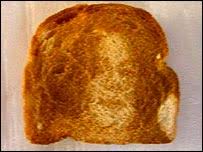
Mary Mother of Toast

This is old news, but it does need reporting again. From me. Because I'm interested.

Apparently the Virgin Mary Mother of God showed up on toast back in 1994. She wasn't content to hang out with God in heaven. She felt the need to impress people with a crumby miracle. So, she emblazoned herself on Diana Duyser's toasted cheese sandwich.

Nice of Mary to show up, really. Now if she would only do that in diners all across the globe. Then I'd be impressed.


That aside, however, I'd like to know if the bread is Wonder Bread. 'Cause wouldn't that just be the most awesomest blending of human ingenuity and divine intervention: "Need you wonder anymore, mortals, what bread thou needest? Thou shalt take of mine Mary loaf and be blessed"? And really, if you're going to theophanize on burnt bread, why not open a franchise and share the miracle with everyone? It'd certainly be a way to outstrip Jesus's feeding of the 5000. He only had five loaves to work with. But Mary, were she to snag a deal with Wonder Bread, would be able to claim the feeding of the, say, 2 billion!

Still, why would Mary want to run the risk of having her head bitten off? Or much more, invite quips such as "Bite me" into her celestial repose?
I wonder if Mary noticed she has some competition in the miracle-toast department? The late King of Pop, Michael Jackson has his face applied in cineresence, too. That's some pretty stiff competition, if you ask me. But Michael was one-up on Mary in this case. He had a prophetic voice that went ahead of him, Weird Al Yankovic, who in his higher wisdom, told us to "Eat it."
And if I could just put one final word in: I think this "miracle" displayed to a 52 year-old, gambling Catholic (sinner!) was rather milquetoast (i.e., timid and weak) of Mary. C'mon, Mary! You can do better than that. Remember the days of Lourdes? What about in Tepeyec, Mexico? Or Akita, Japan? Now those... those were miracles.

Thursday, December 24, 2009

Curious About the Holidays?

Here's one take. Enjoy.

And another one.


For the sentimental folk out there, here's a joyeux noel.


And here's something totally random.

Monday, June 8, 2009

Feeling A Little Like Mother Theresa

Do you ever feel like this?

"I call, I cling, I want ... and there is no One to answer ... no One on Whom I can cling ... no, No One. Alone ... Where is my Faith ... even deep down right in there is nothing, but emptiness & darkness ... My God ... how painful is this unknown pain ... I have no Faith ... I dare not utter the words & thoughts that crowd in my heart ... & make me suffer untold agony.

"So many unanswered questions live within me afraid to uncover them ... because of the blasphemy ... If there be God ... please forgive me ... When I try to raise my thoughts to Heaven there is such convicting emptiness that those very thoughts return like sharp knives & hurt my very soul. I am told God loves me ... and yet the reality of darkness & coldness & emptiness is so great that nothing touches my soul." (Mother Theresa of Calcutta)

I do. And there's no shortage of anxiety that comes with feeling that way.

Sunday, February 8, 2009

Quod Veritas?

At 3 1/2 my eldest son delivered an excellent answer to the long-standing question that has bugged countless philosophers, and was foisted haughtily from the lips of Pilate onto Christ, "What is truth?"

My son's answer?  "Truth is reality as it is for God."  A lot of my thinking has changed since then, and I truly appreciate the unadulterated, and simple wisdom of my son's answer.

God bless him with that kind of wisdom for many years to come.

Tuesday, October 14, 2008

A Skeleton In Their Closet?

Yes, it seems the Catholic Church has to answer to a few questions.  More specifically, was their beloved John Henry Newman gay?  And even if he wasn't, why are they choosing to beatify him and move his grave despite his wishes to be buried by the man he loved, Fr. Ambrose St. John?

More meddling.  More peddling.  I think Luther would've been somewhat irked.