1) This board is a place where ideas/topics/discussions are 'safe'; that is, free from criticism, and the occasional jeers, sneers, and punchy remarks that would naturally be implied from a title like St. Cynic.
2) That this board does not respect differences of opinion.
St. Cynic was not created to be a 'safe' place, a place where conversation can happen without fear of criticism. As anyone who has spent time in any academic circles will know, criticism helps drive improvement, and can also cause the less emotionally stable to feel as if they don't measure up, or are somehow less than others. Having been one of the people who was less emotionally stable during my formal academic years, I can vouch for the fact that criticism can hurt. However, having come through that, I have learned to enjoy the benefits that criticism can engender: sharper thinking, more varied perspectives, keener intuition, and a deeper ability to relate to others even if we hold to different opinions.
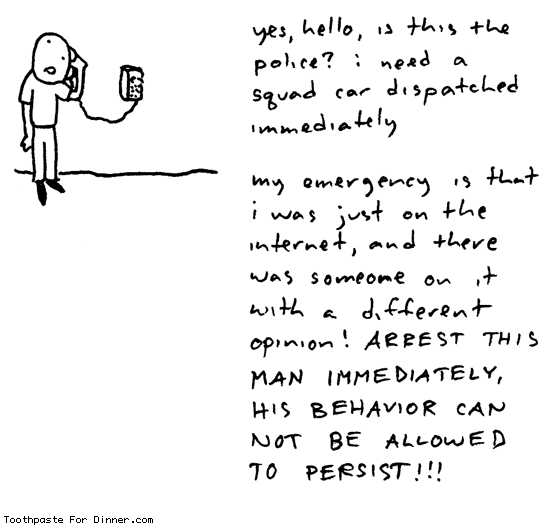
Lately though, it seems as if some people I have criticized, or *gasp* attempted to correct here at St. Cynic have become overwrought. I have received nasty emails, and been scolded in the comments sections. I'm not too concerned about this because I figured it would happen eventually, anyway; telling what you perceive to be the truth, or throwing a few grains of sarcasm at what you perceive to be an absurdity really angers people, it seems. Even more, proposing a view that seems interesting, but that you don't necessarily hold, infuriates some.

What I find interesting about this reality, however, is that these s

ame people would most likely sit down and laugh
with me at more direct attempts at entertainment. For example, if I were to share some viewing time with these people watching a movie like, say,
Dogma, or
Religulous there would be no concern about the criticism those movies offer. There would be no upset with the cynicism, sarcasm, and sometimes even outright hostility brought to bear on the religious via the aforementioned movies. In fact, they would probably provoke some interesting and humourous conversation, and help unveil some mutual perspectives. But open up a blog and deal with religious and philosophical topics with the same eye toward playful sarcasm, and jocular remarks -- well, that's just going too far!
Now those same people who would probably laugh at the movies I listed, once the hot-seat is under them, call my wife and I 'arrogant' and that we 'need to belittle' and cannot be 'civil', and deal with 'theological lightweights', are unable to avoid 'beating around the bush', and are, in fact, 'obtuse'.
Personally, because the intended ironic nature of the board St. Cynic seems to have been lost on these accusers, I have no problem dismissing their concerns as what they are: ad hominem attacks. I don't feel personally liable for their emotional outbursts about the contents of this site, and don't see any reason to change the trajectory of the blog simply because a couple of people don't seem to have the emotional security to deal with responses they may not like.
I do think it is necessary to bring up an old addage, however: if you can't stand the heat, get out of the kitchen. Which is apparently what they've decided to do. Fair enough.
But then I question myself, "Am I treating others the way I would expect to be treated?" Yes! And if the people who have taken offence would care to notice, I haven't (to the best

of my remembrance) leveled a derogatory remark, a personally biting comment, or launced an
ad hominem attack on them at all. Given that, I would find it entirely fair if they were to deal with me in the same teasing, satirical, and punchy way. It's always a welcome opportunity, from my perspective, to laugh at myself and all my missteps, quirks, wrong-headedness, and general asininity.
So, is St. Cynic a 'safe' place? Heavens, no! And it was never intended to be. It has always been my intention with this blog to spur people on, level criticisms, make sarcastic commentaries, and satirize people, places, events, and topics. At the same time, while doing so, I hope to remove some of the barriers to the ways we think by calling down the absurdities of our culture, the religion I participate in, and some of the tripe-filled social conventions we (strangely) trap ourselves in. If you get any of that from this site, great! But if you find a scathing comment, or a mocking picture that happens to hit on something to do with you, don't hold me accountable to how you choose to feel about what I write. And especially don't insult me with petty ad hominems when you run up against your personal limitations. As a wise friend once told me, "sometimes it's good to be offended: it lets you know where you are."

That brings us to the second misconception about
St. Cynic: it does not respect, and is even a 'hostile environment' for differences of
opinion.
Nonsense.
The fact that so many differing opinions have been hosted on this site, examined, questioned, culled from, and dismantled at times is proof to the contrary. St. Cynic, with the intentions I have noted above, is a place specifically for dissenting opinions. And the person who accused me of hosting a 'hostile environment' to different opinions knows my wife and I to dissent from many, if not most, conventional opinions.
That same person has also made regular comments that note a radically different perspective than mine, and they have all been treated with welcome, even complimented at times, and given the same zinger-or-two that anyone can expect from this site. More, some of the readers of this site, who occasionally comment, have remarked that they're happy to have a place where they can air their dissenting perspectives without having to fear ostracization. So it would seem that the evidence stacks against the accusation that St. Cynic is a 'hostile environment' to different opinions. In fact, the evidence seems to suggest that St. Cynic openly welcomes different opinions.
So, as the crass saying goes, "opinions are like assholes: everyone's got one!" If you want to share (an opinion, that is), you're welcome to. Just understand that everyone is equally fodder for fire. If you can handle that, then all will be well at St. Cynic.




 It seems that a little perspective is in order on this blog. A couple of people have become rather upset at the use of sarcasm and irony on the site. In fact, at least one of those people has taken the wry humour of the board much too personally. In light of that, I have decided to write this latest article to correct what seems to me to be two mistakes: