Showing posts with label Catholicism. Show all posts

Sunday, March 13, 2011

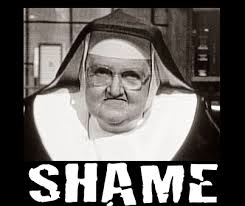
Shame and Catholicism: Bedmates

Denial, shame: Catholic.
First, read this (it's not long, and is quite interesting).

Second, my response to the article linked above:
I personally think that the Catholic heirarchy, were they allowed to legitimately indulge their sexual desires, would have a very different view of sexual intimacy. I really don't hear tale of the Eastern Orthodox church having sexual scandals or legalisms surrounding sexual pleasure between consenting couples. Their priests are allowed to get married, and allowed to enjoy the benefits that confers.
In Catholic quarters, their psycho-social and sexual development is stunted by the blunt force of useless prohibitions on sexual exploration between couples, masturbation, and other harmless hedonisms. Predictably, some Catholic clergy therefore have unacceptable deviances, and Catholic couples are demeaned and disempowered by imposed guilts and harmful preachments about how they should use their body (bawdy!) parts.

I find it a supremely interesting observation that Catholicism stands against legalisms in devotional life (i.e., the notion that one can effect favour with God through efforts at purity) but sets in place a massive legalistic social framework for its adherents (e.g., Canon Law). Is it any wonder that people feel horrible when they come to the instinctual understanding that their devotion to God has resulted in a shame-based identity with their church? This confusion around sexually acceptable practice is one among many, many, many crimes against sanity.
What are your thoughts about this issue?

Wednesday, January 19, 2011

John Paul II: Saintish Update

This blood's for you!
Apparently a vial of the pope's blood drawn from him shortly before his death will be installed in the alter at a Polish church.  This "relic," as it is being described, will serve as a vampiric reminder of John Paul II's something-or-another.  I think it's really rather creepy, to be frank.  But I suppose Catholics will come up with all sorts of theologies surrounding veneration (of the dulia variety, mind), and defend their adoration of a dead man's blood come hell or high water.

Maybe the pope's second miracle will be that he prevents the blood from turning brown.  Or maybe the church will employ a bit of scientific know-how to prevent that from happening.  Personally, I think they should leave it alone and see if this pope is one of the necrotic superheroes, The Incorruptibles.

Tuesday, January 18, 2011

John Paul II: Saintish

Pope John Paul II
Beatification is the first step in making someone a saint in the Catholic tradition.  The late John Paul II, who was pope for almost 27 years (1978 - 2005), will be beatified on May 1st, 2011.  The beatification of John Paul II was approved by the present pope, Benedict XVI, as this BBC article makes clear.

And from the same article, it appears as if a devout nun, who, suffering from the same disease John Paul II suffered himself, prayed to John Paul II two months after the patriarch's death and was miraculously cured.  Sister Marie Simon-Pierre now attributes the remission of her parkinson's disease to the direct intervention of John Paul II, who, being the saintly chap that he is, had God zap her with a cure from beyond the grave.

Of course, such a reductionist and cynical look at the seeming cure of Sister Marie Simon-Pierre really doesn't fall within the official view of the Catholic church, whose envisioning of the activity of the saints is a tad more austere.

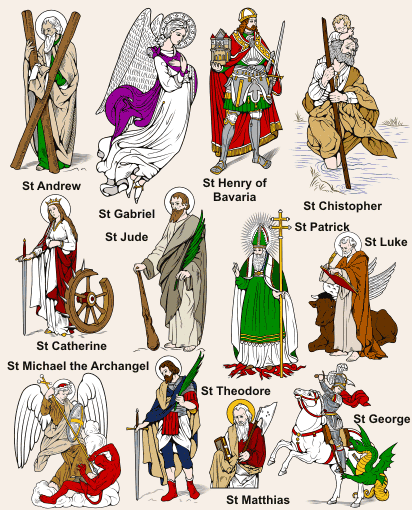
For Catholics, because the saints and beati (those who are not canonized, but nevertheless closer to God in death) are in the presense of God they can attendend to the prayers of the living, and act as intercessors or intermediaries between God and people.  A fulcrum serves the same purpose as a pivoting point between both ends of a teeter-totter.  In short, because of their proximity between God and people, they can run interference.  The point is that the saints continue to serve those left on earth by petitioning God on behalf of the living.  This increases the likelihood of God answering the prayers of the living faithful.  It's kind of like spiritual nepotism, really.

Click to see larger image.
Still, this is only John Paul II's first miracle, so he's not quite good enough to qualify as one of heaven's sanctified élite.  To date, John Paul II, despite being instrumental in more material and explicable miracles like overthrowing Poland's communism, is not quite as awesome as St. Francis of Assisi, whose claims to divine fame were his overweening sentimentality for animals, and his alleged stigmata.  St. Franis did also set up a cluster of cloisters meant to harbour the pious poor, and set out orders for those poor that they had to remain poor if they wanted to be closer to God.  Apparently repressing the human instinct to increase personal security and social mobility is a loftier act of devotion to God than John Paul II's tireless efforts to improve social and religious relationships between Christians, Jews, and Muslims--an improvement the world continues to need rather desperately.  I wonder where we'd be without John Paul II's efforts?

In any case, John Paul II is on track for canonization.  Soon, he'll be part of the rank-and-file of the heavenly élite, schmoozing it up with the likes of Aquinas, Augustine, Mary, Ambrose, Benedict, Patrick, et al.  Though only after he pays his 'Saints Union' fees with one more miracle.

Whatever that miracle might end up being, the one he has apparently effected shortly after his death has the suspicious stamp of having been certified--pay attention now--purely by church sources.  From the BBC article linked above, we read that "Church officials believe that the Polish pope... interceded for the miraculous cure of Sister Marie Simon-Pierre" and that "Church-appointed doctors agreed that there was no medical explanation for the curing of the nun" (italics mine).  Such being the case, I wonder what would've happened with Simon-Pierre's case had purely secular sources investigated the nun's claims?

Doubtless there would be a lot more controversy than the slight ripples caused by a Polish doctor who suggests that Simon-Pierre wasn't suffering from Parkinson's disease but may have found temporary alleviation from a nervous disorder.
"A Polish newspaper said that a doctor who scrutinised the nun's case had concluded that she might have been suffering not from Parkinson's, but from a nervous disorder from which temporary recovery is medically possible."
Everyone and their dog will be praying.
Humbug!  There is no room for scrutiny when the Catholic church has investigated with its own self-interested and self-appointed sources.  Using critical medical counter-explanations could possibly dent the metallic sheen of John Paul II's church-approved miracle.  Such anti-Catholic rhetoric cannot be accepted or allowed to interefere in any way with the gradual additions to the cult of saints.

Nevertheless, John Paul II is, I'm sure, daily being petitioned by faithful Catholics everywhere, who by dint of their prayers, may be able to spur the nigh-sainted pope on to just one more miracle.  Can you imagine being that special person who finally experiences, or at the very least identifies John Paul II at the apogee of his postmortem handiwork?  I'm glad we have living Catholics around to tell us what certain individuals are doing in the afterlife, and that we have big gold stars that read 'saint' to pin to their memories.

Saturday, November 27, 2010

Having Their Cake And Eating It, Too

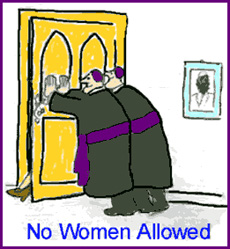
I don't really know anymore if it is morally acceptable for me to pick on such unwitting targets.  However, the Catholic Church really does provide a limitless storehouse of stupidity to whittle away at.  For example, I just learned that the Catholic Church has listed the "attempted ordination of women" amongst their roster of horribly horrible crimes.

The Catholic News Service notes that,
the "attempted ordination of women" will be listed among those crimes, as a serious violation of the sacrament of holy orders, informed sources said. As such, it will be handled under the procedures set up for investigating "delicta graviora" under the control of the doctrinal congregation.
And let's not forget that the delicta graviora is also the same description pinned to such base crimes as "sexual abuse."  So, while it is that the Catholic Church and I can agree that there are a good many actions and states that are horribly immoral, we certainly must part ways when it comes to whether a woman can chant the mass and preach a sermon.  And just for those technically-minded Catholics out there, we can still part ways on whether it is immoral to give a spiritual appointment (ordination) that sets a woman up as an authority in the assemblies of God.  Because while I really see no problem with dashing the hopes of an oudated and repressive patriarchy, those technically-minded Catholic parrots who just put-up with whatever's tossed at them are just as immoral, in my mind, as those people who are actually committing crimes against humanity.

How?  They've decided to jettison their reason in favour of allowing someone else -- namely the pope and his posse of misogynistic cronies -- determine their morality in opposition to observable reality.  In general, this sort of misguided acceptance of a single ruler's decrees is understood as a dictatorship, which most of the world considers immoral and inhumane.  But as long as suppressing and oppressing women is considered acceptable because such actions are declared under the banner of a "religion", then it's fine.  Because once religion is appended to a dictatorship, what is instinctively understood to be really fucking evil, is suddenly moral.

To sum:

1. The Catholic Church and I agree that sexual abuse is wrong, even evil;
2. The Catholic Church and I strongly disagree that attempting to ordain women is just as evil as other crimes against humanity.

Mind you, as an independent entity, Catholics can set up their own rules for self-governance and internal expectations, and women wanting to become priests really ought to look elsewhere.  But when the threat of damnation is extended to people who are not part of "the true Church", why would a sincere believing woman who has all the giftings of a priest not want to be a Catholic priest?  If by not being a Catholic you risk your salvation, then an intensely devout woman who wants to be a priest has to make the decision: forget her dreams and self-identified personhood, or risk her soul.  So, essentially, the priestly woman is damned if she does, and damned if she doesn't.  Looks like the Catholics can have their cake and eat it, too.

But don't worry: that same woman can just go home and have 12 babies, like a good little Catholic.  She can be "saved through childbearing" (1 Tim. 2:15).  You know, where she can find true fulfillment.

Here's another source on the same issue.

Sunday, November 21, 2010

Muzzle the Man, Please

Darth Benedict, head of the Catholic Empire, has used his force to publish a book.  Again.  This time, in Light of the World, one of the topics he tackles is the subject of condom use -- something he and his other spindly-fingered, virgin Sith Lords know a lot about.  I suppose when we want advice, we're all be beholden to the experts, right?

Anyway, Catholicism's chief mouth-breather has announced it to the Empire, and to the scattered remnants of the Rebel Alliance (i.e., Protestants and Non-Catholics alike) that people can hereby use condoms in exceptional circumstances; e.g., if you're going to have sex with a male prostitute.  Or perhaps he should add "if you're going to have sex with a priest."

In any case, people are going to hit the sheets.  There's no exception to that reality.  So, just what kind of "exceptional circumstance" warrants capping one's John-Thomas?  Why, if one's John-Thomas is going to potentially threaten the life of another, of course!  But if you just want to have an hour well-spent with your partner, and not be given over 9 months later to an 18-20 year responsibility, well that's just wrong, evil, sinful, and damnably ungodly.

So are condoms valid in AIDS-riven Africa?

"The Pope made clear in his view condoms were no answer to the Aids pandemic."

So there you have it, commmoners, Darth Benedict has indicated that despite the exceptional circumstances of sexually transmitted diseases that will kill you, they are not the kind of exceptional circumstances that warrant a latex moment. But if you're an African male prostitute, perhaps with AIDS, well that's fine. Go ahead. It's exceptional only when it's exceptional, and not all exceptions are the same. Excepting exceptional circumstances, your circumstances are only exceptional if they're exceptionally exceptional. Then you can put a cap on it. But don't do it if you're just out for some fun. That would make you an evildoer.

Tuesday, June 8, 2010

Mary and Nepotism

I participate on a theology board on occasion. Tonight, a concerned question was raised by a poster named Nightingale. What follows below is Nightingale's question, and my tendency to be cheeky while attempting a playful point.
In researching the development of Marian dogma, I've found that most of the first Protestants held a very high opinion of Mary. Both Luther and Calvin believed in her perpetual virginity and divine maternity, Luther believed in her immaculate conception, and Oecolampadius even taught that she was the Mediatrix of all graces! Why has this switched around to the point where I've heard many Protestants discourage even talking about Mary?
Remember the context of the time: Luther and Calvin were both Catholic priests before they reacted against Rome. Those things that were relevant to worship, they kept. Those things that they deemed hinderances, they tossed.

That same tradition continued post-Luther, post-Calvin. Even more than the Reformers, however, were the Radicals (sometimes known as the Anabaptists) and their maniacal fervour to reduce Christianity to some basic sediments, and dispense with the froth and foam. They considered Luther heroic, yes; but they also thought he didn't go far enough. Hence they set in motion a type of puritanism that acted as a distilate to anything beyond the pale of scripture, preaching, and symbolic sacraments. Thus Mary, while respectable, really was only instrumental insofar as she birthed Jesus. After that, she's little more than a biblical after-thought.

Carry that same creeping puritanism forward to the present day, and you have some memetic tendencies in Protestant circles to dispense with Mary altogether because she seems to get in the way of Jesus by being part of a grammar people are afraid will lead to Catholicism.

Despite my hearty agreeance that Catholicism is a frightening thing, for most Prostestants it is an evil thing. And if Mary is going to have the dogmatic fortitude to be mediating between Jesus and the rest of the world, then the misgivings of Protestants will no doubt exculpate her from such a nepotistic scheme, and set her where she belongs: in a manger, and at the foot of the cross, and no more.

Thursday, May 20, 2010

Catholic Collusion

The Catholic “Declaration on the Production and the Scientific and Therapeutic Use of Human Embryonic Stem Cells,” makes a fitting irony alongside its other inclinations, wouldn't you agree?


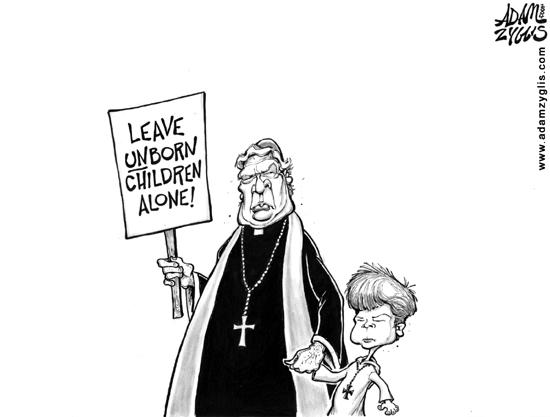
Yes, that's right: they're fine with covering-up the rape and torture of children, but you damn-well better leave those stem-cells alone.

Monday, April 12, 2010

Argument from Historical Proximity: Invalid

I've been writing about my migivings with Catholicism lately. I've also been semi-debating an aspiring Catholic philosopher. Why the sudden focus on Catholic thought? I'm not sure. However, something occured to me today, and I'd like to share it.

Getting into academic jousting matches with Catholic apologists (and a good many Protestant Evangelicals, too, just to be clear) over differences in doctrine, or even just the sensibility of this-or-that doctrine has highlighted a tactic often used against me. I'd like to call the tactic in question, "The Argument from Historical Proximity."

The argument is as follows: historical figures closer to the time of Jesus have a greater, more precise understanding of the details attending Jesus's life, and the lives of people close to Jesus (e.g., the Apostles, Mary, the first Christians, etc.). So, if I were to argue that recent historical research casts reasonable doubt on the perpetual virginity of Mary, the argument from historical proximity would counter that Mary was most definitely ever-virgin because the writings of the early church fathers state as much. And because the early church fathers lived closer to the time of Mary, they would have more reliable claims on the status of Mary's bedroom activities than today's historians. The assumption is essentially that the less the passage of time, the more accurate the claim, and the less chance of distortions to confuse the claim.

On the surface, the argument seems to carry with it some validity: it seems reasonable to think that people in the second century would have less confusions to work through than people in the twenty-first century concerning church beliefs. But given a moment's thought, the argument breaks down on a crucial point.

If we reason from historical proximity, then we have to be willing to accept opposing claims as valid, too. The Roman historian Tacitus (AD 56 - 117) wrote extremely close to the time of Jesus and the first Christians, and was a contemporary of the early church fathers. Tacitus considered Christianity a "deadly superstition"; i.e., it was a grave error, and a falsehood. Emperor Domitian (AD 51 - 96) claimed that Christians were 'atheists' and slaughtered them. Pliny the Younger (AD 61 - ca. 112) commissioned the murder of Christians because he considered them hedonists and cannibals.

So, if we take claims opposing Christianity on equal footing with Catholic arguments from historical proximity, then we can reasonably say that Christians believed falsehoods, and were orgiastic cannibals who believed in an untrue God.

Clearly, the argument from historical proximity is groundless; just as groundless as it would be to argue for the falsehood of Christianity by claiming Tacitus, Domitian, or Pliny the Younger as truth-measures. Christians, and Catholics especially, need to move on to better methods of truth-seeking than quixotic claims to historical proximity.

Sunday, April 11, 2010

Arresting the Pope: Good

Richard Dawkins and Christopher Hitchens are planning on arresting the pope. Here is the article.

Good!
He should be arrested. Anyone else doing what he's done would be charged with conspiring, and aiding and enabling criminal activity. Oh, but because he's religious, he's beyond justice. *cough, cough* Bullshit!

Thursday, April 8, 2010

Sexrosanct

Mary's perpetual virginity. Ever a popular sentiment amongst Catholics, but one which seems at odds with reality.

Before I respond to the Catholic blither and blather of Mary's reproductive prudery, let's survey what it is Catholics believe on this count.

First, Mary was a virgin before, during, and after Jesus' birth. Second, after Jesus was born, Mary never engaged in sexual congress with her husband, Joseph. Third, Mary's perpetual virginity is distinct from the Immaculate Conception of Mary; the former refers to Mary's inconsummate marriage to Joseph, the latter to Mary's being born into the world without the stain of original sin. And finally, fourth, Mary's virginal status means that Jesus had no siblings. While being an obvious point, it is important to note number four because it provides a ready-steady defense for the use of the words "the brothers of Jesus" (Matt. 13:55; Mk. 6:3) to allegedly mean "cousins of Jesus".

If the gospel accounts of Jesus' arrival in this world are true, then there is no difficulty believing that Jesus' mother was a virgin before his birth, and during his birth. It was customary of Mary's time -- and is even sensibly encouraged today -- to abstain from sexual intercourse before marriage. Mary was betrothed (i.e., engaged, to use modern terminology) to Joseph when she became pregnant with Jesus, which, to Joseph, appeared as infidelity until he was reassured by an angel that all was well, and that Mary was pregnant by God's doing.

This in itself seems like a peculiar infidelity that God would impregnate another man's wife (I think Zeus was prone to the same misgivings, so no surprise a similar motif would show up in a Hellenistic culture). Leaving that aside, however, if it was that Mary was born without sin, why couldn't God simply have used Mary and Joseph's eventual union to create another sinless person, but this time one that also happened to be God? Afterall, he created people from dirt; I'm fairly certain he could funnel himself through an egg.

All of the above notwithstanding, unless Mary remained betrothed to Joseph forever after, that is, unless Mary and Joseph together decided they would never get married but just live together raising Jesus, it seems unlikely, even supremely implausible that Mary remained a virgin after Jesus' birth. Two things come to mind at this point:
  1. Mary and Joseph were religious Jews, and so, would not have lived together as a couple without being married; not unless they wanted to be stoned to death (recall the historical time and prevailing religion) for being considered fornicators;
  2. It has always been the sexual act that seals a marriage, that makes the covenantal bond between two people and the God/gods they are loyal to.
Given number two above, we would do well to keep in mind a tiny, niggling, insignificant triffle of a point: Catholics, by and large, believe that Scripture is God's inspired and inerrant word (set of writings) that is necessary and sufficient for understanding all matters of faith and morals. So let's just assume for a moment that Mary actually was married to Joseph, but the two remained celibate and thus preserved Mary's virginity. I think it would be fair to say that Joseph, unless he was one of the eunuchs Jesus later referred to (Matt. 19:11-12), might have "burned with passion" for Mary. And if Joseph had committed himself to live inconsummately with Mary, all-the-while lusting after her, it would seem that we have a couple of plausible contradictions:
  1. Mary and Joseph were witholding from each other, even knowing that at least one of them was desirous. This is a sin (see 1 Cor. 7:5) because it invites temptation into the marriage, and should only be done for a limited time; time enough for prayer and fasting, and then they were to enjoy marital bliss again.
  2. If it was sinful to withold from each other, then Mary's immaculate status is negated because she would've been sinning to enter a permanent, sexless marriage where one or both of the people involved would be sexually ungratified and desirous.
"Ah!" says the Catholic apologist, "you cannot hold Mary to a standard that God instituted through St. Paul approximately 35 years after Christ's death." Well, sure I can. And here's how: we're talking about what Catholics have always believed, not what they've ever known. There is not a single source in either scripture or tradition that can point to de facto proof that Mary never consummated her (eventual) marriage to Joseph. Thus what Catholics believe about Mary's permanent virginal status has no relationship with anything actually known. It is a supposition that lends Catholics a strange comfort, but seems at odds with reality when parsed by a slight flexing of practical logic.

There is a direct relationship between Mary's assumed lack of original sin, and the Catholic claim that she was/is ever a virgin. The doctrine of original sin found its first expressions in the writings of Irenaeus, bishop of Lyon, when he was arguing with Gnostics. But the champion of the doctrine of original sin, however, was Augustine, bishop of Hippo. Augustine reasoned that
original sin was both an act of foolishness (insipientia) and of pride and disobedience to God of Adam and Eve. He thought it was a most subtle job to discern what came first: self-centeredness or failure in seeing truth. The sin would not have taken place, if satan hadn't sown into their senses "the root of evil” (radix Mali).
But apparently Satan did plant a 'root of evil' into our nature such that our whole humanity -- that is, those things that constitute our unique human characteristics -- was forever wounded, depleted, broken. Characteristics such as our intelligence, affectations, sexual desires, and will were permanently enfeebled, according to Thomas Aquinas' rendering of Augustine. This enfeeblement is passed down, or transmitted, from Adam and Eve to all of humanity by way of concupiscence; that is, desire. The next logical step from desire being the transmitter of human enfeeblement is to suggest that the sexual reproductive act (the only way new people are made) is the purveyor of original sin.

This in itself does not make the sexual act wrong in Catholic theology. However, because Mary was to be the bearer of God himself, there could be no taint of sin in her. Hence Mary's parents' copulation, somehow, didn't transmit a wounded nature to Mary (how convenient, yet, sadly, entirely presumptuous). Mary was, it is supposed in Catholicism, therefore perfect in her human nature. Thus for Mary to engage in coitus with Joseph would imply the possible transmission of human sinfulness to any offspring copulating may produce. Since God had housed himself in Mary's womb, any post-Jesus children would be (conspicuously) bad, because apparently God and people shouldn't intermingle -- which brings up a whole other set of issues. For example, a smattering of gnosticism. But I digress...

Mary was above all base nonsense such as human sexuality; that seems to be the implication. In her perfection (lack of sin), she would not debase herself with the thrusts and stilted grunts of her imperfect husband. Never! The connection is clear: human woundedness is continued through sexual reproduction, which is beneath perfect people like Mary, so she abstained from conjugal relations with Joseph, who in turn probably experienced unbridled sexual frustration and was, due to an attrition of sorts, consigned to masturbation (which is also a sin in Catholicism). That is, unless by way of physical proximity to Mary, Joseph was able to master his sexual urges and content himself with a faux marriage; an unlikely possibility given the matrimonial customs of the time.

Before moving on to my last point, I will review, in short, the gist of my first three points:

  1. Mary would not have lived in a false marriage arrangement because this would implicate Mary and Joseph on the grounds of sexual sin: the surrounding community would've viewed a couple living together, and having a child together out of wedlock, as fornication.
  2. Mary's blameless and perfect nature would be blatantly stained by purposefully, and knowingly entering into a sexless marriage where her weaker, imperfect husband, Joseph, would burn after her with lust; i.e., Mary would've purposefully been tempting Joseph to sin.
  3. Mary's ever-virgin status, when distilled to its constituent elements, constitutes a form of gnosticism: she could not have copulated with one who bears the stain of original sin because her womb held the son of God; the perfection of God and Mary could not intermingle with the imperfection of a man.
These three criticisms give credit to the more sensible notion that Mary probably enjoyed her marriage as fully as any healthy married pair should. They also lend strength to the argument that Jesus most likely had brothers that were not simply 'cousins', but flesh-and-blood brothers. It is argued that when the Greek word adelphoi (brothers) was written into Scripture, it wasn't with the intention to convey a direct statement about the status of James, Joseph, Simon, and Judas being related to Jesus (Matt. 13:55; Mk. 6:3). Heavens, no! Why keep things simple? Instead, concoct a story that they're all just 'cousins', or half-brothers from a previous relationship Joseph enjoyed. This is a blatant violation of Occam's principle of parsimony, and highlights the useless convolutions Catholics are willing to accept in order to hold in high regard a dogma that has no foothold in reality.

And this, in itself, begs an obvious question. If it is true that Joseph had enjoyed a previous marriage, and then entered into a marriage with Mary, why would he want to give up one of the specific pleasures marriage allows: sex? Unless it can be argued from silence -- as assuredly Joseph's possible previous marriage is an argumentum ex silentio -- that Joseph was done with coitus funness when he set his eyes on Mary, there's nothing to support the notion that Joseph would willingly enter into a sexless marriage. At the same time, to give credit where it's due, there's nothing to support the notion that Joseph would not enter into a sexless marriage. In either case, we have absolutely no evidence at all to conclude on the virginal status of Mary, and Joseph's willingness or not to entertain an inconsummate marriage.

In conclusion, I think that the notion of Mary's perpetual virginity is purely a fabrication. Yes, many people have believed it for a good long time. However, the duration of a belief is no argument for its validity. Many people believed that the earth was flat for quite some time, but that is clearly not the case. From the reasons given by the Catholic church for Mary's eternal virginity, I have reflected some practical conclusions that show the weaknesses in the expectation that Mary was inconsummate in her marriage to Joseph. I could go on drawing further conclusions from the beliefs set out by Catholics, but it seems sufficient to say that Mary's constant virginity is a proposition based in silence, that when examined in a little detail becomes self-contradictory, disregards Occam's razor, highlights Catholic antisexualism, and therefore has no basis in reality.

Friday, April 2, 2010

Ratzinger's Plausible Deniability Is Bunk

Apparently the pope needs no defense: he's clean, he's without stain, and he never involved himself in the alleged cover-up of child-raping priests. Everybody should be slapped on the hand for even thinking that Ratzinger might have something to do with protecting deviant priests, and the image of the church. Afterall, that reporter shouldn't have been so insidiously rebellious to question the authority of a leader he has no allegiance to. He deserved that slap. We should all practice assault when we don't like how questions make us feel, or when they show up our hyporcisy.

On the other side of papal obstructions to justice, the Vatican has offered three reasons why it isn't liable for the abuses thousands of its faithful have endured over the past 50 years:
  1. As the head of the Vatican, a city-state, the pope has immunity;
  2. American bishops who abused thousands of wee uns weren't actually employed by the Vatican;
  3. The 1962 document Crimen Sollicitationis does not provide proof of a cover-up.

Perhaps I'm out of my depth making comments on international politics and their interface with religious powers and power-mongers (e.g., the pope). So be it. But it does seem a matter of practical logic, to me, that if crimes are committed internationally, by priests of various nationalities, and who all happen to trace their legal fiat back to a single religio-political entity called The Vatican, that perhaps that single religio-political entity and the person who oversees it should be made accountable for the actions of the people he is claiming sovereignty over.

When Saddam Hussein slaughtered the Kurdish people, his immunity as head of the Iraqi state wasn't worth spit. On December 30th, 2006, Hussein was executed for his crimes against humanity. I'm certainly not calling for the exectution of the pope, not by any means. However, I am concerned that the pope's factual involvement in protecting the image of Catholicism, and the offices of the priests under him, amounts to nothing more than a chance for Ratzinger to plead plausible deniability on the world stage.

Let him deny it, if he dares. But to then move on and say that the bishops involved in covering up the actions of lecherous priests were not actually employed by the Vatican is a clear-cut case of four-square stupidity. If they weren't employed by the Vatican, they wouldn't have been acting in their offices. There wouldn't be any question of their alleged cover-ups because they wouldn't have been Catholic bishops. How fucking stupid do they really think the observing public is? The medieval period is over, Ratzinger. We're not baffled by ecclesial Latin anymore, and you certainly can't moonshine us any longer by suddenly changing the story and preying on our illiteracy.

Still, Crimen Sollicitationis is not proof of a cover-up. I'll quote the document, and you be the judge about whether it is a blatant attempt to keep sexual crimes secret, or just an exercise in fancy rhetoric.

"As, assuredly, what must be mainly taken care of and complied with in handling these trials is that they be managed with maximum confidentiality and after the verdict is declared and put into effect never be mentioned again (20 February 1867 Instruction of the Holy Office, 14), each and every person, who in any way belongs to the tribunal or is given knowledge of the matter because of their office, is obliged to keep inviolate the strictest secrecy (what is commonly called "the secrecy of the Holy Office") in all things and with all persons, under pain of automatic (latae sententiae) excommunication, incurred ipso facto without need of any declaration other than the present one, and reserved to the Supreme Pontiff in person alone, excluding even the Apostolic Penitentiary."

To end this article, I would like to draw your attention to the words of Christopher Hitchens, who wrote the following on March 29th, 2010. I echo his sentiments, and could not have phrased them any better.

"This is what makes the scandal an institutional one and not a matter of delinquency here and there. The church needs and wants control of the very young and asks their parents to entrust their children to certain "confessors," who until recently enjoyed enormous prestige and immunity. It cannot afford to admit that many of these confessors, and their superiors, are calcified sadists who cannot believe their luck. Nor can it afford to admit that the church regularly abandoned the children and did its best to protect and sometimes even promote their tormentors. So instead it is whiningly and falsely asserting that all charges against the pope—none of them surfacing except from within the Catholic community—are part of a plan to embarrass him.

This hasn't been true so far, but it ought to be true from now on. This grisly little man is not above or outside the law. He is the titular head of a small state. We know more and more of the names of the children who were victims and of the pederasts who were his pets. This is a crime under any law (as well as a sin), and crime demands not sickly private ceremonies of "repentance," or faux compensation by means of church-financed payoffs, but justice and punishment. The secular authorities have been feeble for too long but now some lawyers and prosecutors are starting to bestir themselves. I know some serious men of law who are discussing what to do if Benedict tries to make his
proposed visit to Britain in the fall. It's enough. There has to be a reckoning, and it should start now."

Monday, March 22, 2010

Step Down Ratzinger

More needs to be said about the current scandals attending the Catholic Church. But saying more is difficult when the lasting effect of such moral depravity is to be slackjawed and shocked. Keeping close to developments is impossible, since the scandals are widening relentlessly across Europe, and sources are turning out information at an alarming pace.

Most recently, the pope has issued an apology to Irish victims of clergy-enforced sexual abuse. The contents of the letter certainly do make note of the fact that abuse has happened, and that it is terrible that such a reality exists. Says Ratzinger (I now refuse to call him by his self-decided honorific name):
Like yourselves, I have been deeply disturbed by the information which has come to light regarding the abuse of children and vulnerable young people by members of the Church in Ireland, particularly by priests and religious.
I would be remiss to suggest that Ratzinger is not sincere in his lamentations but for one peculiar quibble: he is directly reponsible for the reason why the disturbing information regarding child-rape is only now coming to light.

Within the matrix of Catholicism, priests and bishops who make grave offenses against the public are to be tried infront of a church tribunal. That tribunal is sworn to the strictest secrecy upon threat of excommunication if any of the tribunal leaks information regarding offending clergy (see, Crimen Sollicitationis).
As, assuredly, what must be mainly taken care of and complied with in handling these trials is that they be managed with maximum confidentiality and after the verdict is declared and put into effect never be mentioned again (20 February 1867 Instruction of the Holy Office, 14), each and every person, who in any way belongs to the tribunal or is given knowledge of the matter because of their office, is obliged to keep inviolate the strictest secrecy (what is commonly called "the secrecy of the Holy Office") in all things and with all persons, under pain of automatic (latae sententiae) excommunication...
Crimen Sollicitationis received backing by Ratzinger in 2001, and was, in fact, enforced by Ratzinger for 20 years prior to his election to pope in 2005. Confidentiality itself is not bad conduct, but when it is used as a control mechanism -- as Ratzinger, in fact, has used it -- to suppress the goings-on of serial abusers, to cover-up mortal crimes, and divert the attention of the public away from alleged abusers, one has to call into question the actual purpose of that confidentiality.

Says Father Tom Doyle, Canon Lawyer, in a BBC Documenary, Sex Crimes and the Vatican,
Crimen sollicitationis is indicative of a world-wide policy of absolute secrecy and control of all cases of sexual abuse by the clergy. But what you really have here is an explicit written policy to cover up cases of child sexual abuse by the clergy, to punish those who would call attention to these crimes by churchmen. You've got a written policy that says the Vatican will control these situations, and you also have, I think, clear written evidence of the fact that all they're concerned about is containing and controlling the problem. Nowhere in any of these documents does it say anything about helping the victims. The only thing it does is say that they can impose fear on the victims, and punish the victims, for discussing or disclosing what had happened to them.
Indeed, Ratzinger has consciously orchestrated the scandal he is now the centerpiece of: by enforcing crimen sollicitationis, priests and bishops have stood with toothy grins in front of a 'holy' tribunal and, at worst, come away defrocked, but more likely scuttled-off to another parish with full access to children (future victims).

Given Ratzinger's 'disturbance' that the crimes he fought so desperately to keep secret are now in the public eye, I wholeheartedly reject his milquetoast apology, and call on him to step down. Nevermind the juridical reign of the Roman bishop, the in-office-'till-death mentality; have the moral fortitude to resign your office and be done with your hypocritical charade. Prove you have some quality left in you by removing yourself from 'supreme authority' over the church, and standing trial in a secular court for your brazen obstructions of justice, and your intentional use of truth-suppression and diversionary tactics.

Christopher Hitchens
, reporting on this issue once again in his recent article Tear Down That Wall, states,
Pope Benedict's pathetic and euphemistic letter to his "flock" in Ireland doesn't even propose that such people should lose their positions in the church. And this cowardly guardedness on his part is for a good and sufficient reason: If there was to be a serious criminal investigation, it would have to depose the pope himself.
So while the fact remains that all of this abuse has happened, an equally disturbing fact has surfaced: the "vicar of Christ on earth", the pope himself has led a charge into purposeful lying, deceit, and evasion. If we were to remove the religious motif from this scandal just for the purpose of speculation, what do we think would be the result of these abuses and cover-ups in the real world? Trials would be held, people would be jailed, recompense (if that is even possible given the nature of the crime) would be levied, and in some places the criminals might even be executed.

But because the criminals are dyed-in-the-wool clergy, they can somehow claim religious immunity and be insulated from the world courts. This alone is criminal, and should be loudly protested. The pope's letter is a disgrace. I don't think I'm alone in suggesting that the only way any of this can get better is if the pope relieves himself of his office, and the entire system of Catholicism itself gasps its last breath.

Saturday, March 20, 2010

The Pope, the Gates of Hell, and Useless Apologies

The devil's in the Vatican. Paedophile priests. A history of ambiguous relations to some of the most despotic and villainous leaders of all time (Hitler and Pius XII, for example). Residential schools. Witch-hunts. The selling of Indulgences to Europe's poor to facilitate the building of St. Peter's basillica. The Inquisition. Sociopathic Popes more inclined to murder and rape than teach doctrines of love and charity. Cover-ups and scandals heaped on cover-ups and scandals.

All of these things and more coming out of a church that claims a laughable duology of doctrines that it is the "one true church", and that "the gates of hell will not prevail against [it]". Assuming Catholic claims are true that it is the 'one true church', it would seem stupidly obvious that hell has not needed to prevail against its gates: hell has been rather successfully living itself out within the church for quite a while now. If there's to be any gate crashing, let's hope it will eventually be by an internal movement to get the hell out.

Fortunately, there has been a recent spate of sex abuse scandals in Europe that expose the current pope's collusions and cover-ups, and a rather wide ring of child-raping priests. The current pope, Benedict XVI (formerly Cardinal Joseph Ratzinger, and oft-named Pope Palpatine) has, for a long time now, been indisputably involved in not only shuffling off psychopathic priests, but also shuffling off the justice that should be visited upon them.

As Johann Hari reports:
Far from changing this paedophile-protecting model, Ratzinger reinforced it. In 2001 he issued a strict secret order demanding that charges of child-rape should be investigated by the Church "in the most secretive way... restrained by a perpetual silence... and everyone... is to observe the strictest secret."
It doesn't stop there, however. As Christopher Hitchens points out in his article The Great Catholic Cover-Up
The accusations, intoned Ratzinger, were only treatable within the church's own exclusive jurisdiction. Any sharing of the evidence with legal authorities or the press was utterly forbidden. Charges were to be investigated "in the most secretive way ... restrained by a perpetual silence ... and everyone ... is to observe the strictest secret which is commonly regarded as a secret of the Holy Office … under the penalty of excommunication." (My italics). Nobody has yet been excommunicated for the rape and torture of children, but exposing the offense could get you into serious trouble. And this is the church that warns us against moral relativism! (See, for more on this appalling document, two reports in the London Observer of April 24, 2005, by Jamie Doward.)
It would be fair of a Catholic apologete to question my sources. Both Hari and Hitchens are, admittedly, atheists. However, given the history of Catholic deceptions, and the urgent spot Catholics find themselves in at present, I have no reason to trust Catholic sources at all. Too much is at stake, and their practice of moonshining the public about their moral turpitude gives them all the more reason to diminish the impact of the situation through sophistry, and doublespeak (e.g., the Catholic church never errs in matters of faith and morals).

And the fact that Benedict XVI has delivered an apology to Ireland's abused today (March 20th, 2010) does nothing more to ameliorate the problem than an abusing husband's repeated apologies for kicking the shit out of his wife: the offense is still alive, and will likely continue to happen. Why? Because it's not the fact that paedophile priests exist in the clergy of the Catholic church that is the greatest concern -- though it is certainly an incredibly important concern. The reason why these kinds of offenses will continue is because the system of the Catholic church that enables and harbours paedophile priests is not likely to change. That, to me, is the greatest scandal in all of this: that there is no way to get rid of the abuse problem unless the Catholic system dissolves itself, a reality we know will not happen, but we'd all be better off with if it did.

Sunday, March 14, 2010

The Vatican and the Devil

Apparently the Vatican is possessed. Well, maybe not possessed as such, but definitely not doing too well in its fight against the devil. At this point, some cynics might add the words of Christ that "a house divided against itself surely cannot stand" (Matt. 12:25).

But that's okay, really, because the gates of hell won't win out against the Holy See, right? 'Cause it was a religious city-state Jesus was talking about when he assured his followers that hell would do its best but fail in its attempt to replicate the falling of the walls at Jericho. Where's Linda Blair when we need some head-spinning proof?

E.T.A.: Is the Holy See really endorsing the "devil made me do it" excuse for all their misdeeds? Pedophile priests, ambiguity toward genocide (Pius XII), residential schools, witch-burnings, the Crusades, etc... It all falls under the clause "the devil made me do it"? What kind of wing-nuttery runs the Vatican? Who are these dottering fools that they can write-off their personal culpability, their responsibility and accountability by stating that it's the devil's fault?

Nevertheless, I think the chief exorcist is right: the devil is in the Vatican. He's a legion of priests, bishops, and deacons that use their position to exploit the vulnerabilities of others. And who can hold them accountable? No-one. They are an autonomous entity enveloped within the religious city-state called The Vatican. They answer to themselves, and hold court on their own, by their own terms, and in their own time. And despite how much they like to reach out and touch others, they are themselves completely untouchable.

E.T.A. #2: Christopher Hitchens has weighed in on the issue, and I have to say that I quite agree with his conclusions. Read for yourself here. And for a more in-depth depiction of the cirque du corps rampant in the Catholic church of late, here's Foreign Policy's article.

Tuesday, February 2, 2010

The Never Erring Story P. III

Apparently Gregory finds my posts on Catholic doctrine to be misguided, and not worth his time until I correctly define the doctrines I'm contending with. At the same time, in poor debate form, Gregory offers no definitions of his own, so, in some crude, horizontal twist of ultramontanism, I'm supposed to just believe him because he said so. How very Catholic.

More, it seems that Gregory thinks my wife, Imogen, is a voice-piece for my concerns: "Since she decided to weigh in on our discussion, I assumed you two must be working as a unit, and the adjective ['vitriol'] applied on both sides." Still, Gregory did "apologise" if this is not the case. But I can't help thinking that the maxim 'too little too late' applies nicely here. For why would Gregory even assume that my wife and I are incapable of thinking apart from each other? What measure of presumption leads a person to such a conclusion? And after admitting that he "...didn't have time to read all the way through. Read enough to get annoyed again, though", too! Fine measuring stick, Gregory: get annoyed at an article you haven't fully read, assume later that my wife and I are occupying the same voice, and then mete out a response? Poor form, my friend. Poor form.

Let me be clear about Imogen's position, since you seem not to have understood from her writings themselves: she quite literally does not care what definitions Catholicism wants to place on notions of impeccability, inerrancy, infallibility. That's her last concern, if it even is at all. She is not, never has been, and does not foresee ever being a Catholic, so she is not bound to whatever spin Catholicism wants to place on the words they choose.

What Imogen is concerned with is the lived-out reality of the Catholic Church, the people it effects, and the fact that billions of people are held in sway under a superstructure that enforces manditory beliefs. She's concerned about the intellectual tyranny of Catholicism, to put it in brief. She's concerned that the Catholic Magisterium finds it a viable line of thinking to set out statements that are not only binding on 1.1 billion believers, but that there seems to be no recognition that in the face of 5.6 billion other people there may be a chance that Catholicism could have missed some understanding while it prattles endlessly about its absolutist doctrines.

What I am concerned about is the fact that no matter how much the Catholic church is brought to task by concerned parties, if they are non-Catholics, they apparently don't understand. I'm sure that's probably true in a number of cases. However, I am equally sure it is not the case for everyone who has what they perceive as legitimate concerns.

This is where I charge Catholics, loosely, with gnosticism. To be clear, however, Catholics are not one of the historical groups of Gnostics. Catholics practice gnosticism by being a self-selected group that deny understanding to non-Catholics to the point that they are willing to assert that they have "the fulness of the faith", the "one true faith." The formal implications, of course, being that all other non-Catholics are somehow deficient, under the captivity of lies, or unable to enjoy the same richness of faith and understanding unless somehow initiated (e.g., R.C.I.A.) into the rank-and-file of Catholics.

Nevermind that other churches are considered 'valid' (as if that hat-tipping concession really means anything useful at all); they are not as elevated, as close to God, as 'full' or 'near to the truth' as Catholics are. What kind of neurotic hubris goes before such snobbish bullshit, anyway? "Yes, you're Christians. But you're not as high a quality Christian as you would be if you bore the indelible stamp of our papally approved doctrines."

Nevertheless, from the time I started debating with Catholics, I've never witnessed a case where the non-Catholic is validated as understanding this-or-that Catholic proposition. As soon as a Catholic is pushed into a corner by force of another's concerns, the old Catholic stand-by is "you don't understand; your definitions are wrong; you can't understand because you're not Catholic." In other words, I'm concerned that the rampant in-group/out-group mentality of the Catholic Church is belief by social pressure, not necessarily by a clear conscience and a willing conviciton.

More, the fact that Catholic beliefs are conscripted renders the beliefs of Catholics largely "belief in belief", to borrow Daniel C. Dennett's term. I'm sure many Catholics sincerely believe Jesus was real, that he rose from the dead, and all that basic dogma. However, enforcing much more than that (e.g., the assumption of Mary, Extra Ecclesium nulla salus, The Communion of the Saints, et al.) is a coercion of belief. That is, a Catholic cannot truly be Catholic unless s/he willingly takes on the convictions of a brace of dead people that declared this-that-or-another proposition true because they believed it (i.e., Tradition). This degenerative reasoning process is, as I've pointed out before, performative logic (what is said constitutes the thing referred to; or, what is said becomes its own proof, or point of reference).

So, the first and most important error in Catholicism is not that it declares certain of its doctrines free of error, but that it conscripts belief from a largely naive population of well-meaning Christians. The second error is that one of those conscripted beliefs is that Catholics are to believe in the belief that the Catholic Church never errs in matters of faith and morals. That, properly speaking, is not belief, but propaganda and pretence.

Of course, people are free to not become Catholics (now) but they are still considered second-class Christians, which is the third error in the teachings of Catholicism, and it effectively equals bigotry. The same charge of bigotry can be levelled against almost all Christian denominations, so Catholicism is, in this instance, not uniquely isolated. However, Catholicism makes it a point to absolve itself of this error by immodestly claiming its inerrancy in matters of faith and morals, so it opens itself up to freethinking criticism, and cannot escape the attention given to this issue no matter how proficient it is at back-pedaling, splitting hairs, and jumping between literal and figurative meanings when it suits its interests, or serves its purposes.

Yes, we can modify the statement "without errors in matters of faith and morals" to read, as Ed suggested, "The Catholic Church has never, can never, and will never err in HER OFFICIAL TEACHING ON matters pertaining to faith and morals," but that does next to nothing to alleviate the spuriousness of such a claim. As Ed continued to note, the Catholic Church considers certain teachings to have a special status. But so what? So they are claimed to have a special status. This simply implies the notion of a hierarchy of truths in Catholicism, which is purely notional and not demonstrable as actual.

And the fact that truths are ranked by some pre-determined levels of certainty (hierarchy of truths) requires that the stated case that there is a hierarchy of truth would form the ultimate truth about truth, the ultimate certainty about certainty. That is another reason for that particular teaching to be held in suspicion: truths of that magnitude, that is, truths that are so truly true that they are undeniable would be self-evident, one might reasonably assume. Kind of like noting that everyone dies: it's simply obvious and undeniable. The immaculate conception of Mary? Not so much. It's simply propositional, and then somewhere along the line of Catholic hermeneutic convolutions it becomes performative. I don't buy that kind of rigorous nonsense, no matter how neatly packaged in fancy rhetoric it is.

Which brings us back to Gregory's desire for me to define the terms I take difference with: impeccability and infallibility. And unless I use the Catholic doctrinal definitions, what I have to say is not worth his time. Why? Because unless I do that, I am apparently setting up a straw man argument. Very well then, here are your church's definitions:
  1. Infallibility: "In general, exemption or immunity from liability to error or failure; in particular in theological usage, the supernatural prerogative by which the Church of Christ is, by a special Divine assistance, preserved from liability to error in her definitive dogmatic teaching regarding matters of faith and morals."
  2. Impeccability: On this point, I admit that I confused infallibility with impeccability (sinlessness) when I was criticizing the errors of the Catholic church, even after I made note that they are often confused. I suppose that is a truth now proved. What is more, I cannot find any reliable sources (at this point) that lay out a concise Catholic definition of impeccability. So, I offer Wikipedia's definition.

Nevertheless, my contentions about the claim that the "Catholic Church, in her official teachings, has never, can never, and will never err" remain. Especially concerning "can never" and "will never", for unless such sophistry is divine prophesy, the Catholic church simply has no place to spout such trumpery.

What is more, I reject and utterly refuse the notion of impeccability being a quality of Mary, as do some Catholic theologians. It is a quirky irony that Catholicism condemned Pelagianism (people in co-operation with divinely revealed truths can live without sin), but allowed that Mary was able, through her co-operative will, to avoid sinning. Why condemn the one, but allow the other? And even if we consider the official teaching of the Magisterium that Mary was 'preserved' from sin by a special dolloping of grace, even at the time of her conception, we are left with the question, 'Why would he kill his son to save the rest of us, when it is at least anecdotally clear that he could've just tweaked the grace-factor in everyone's favour to begin with?' It seems from that that either God is a sadist, or the Catholic Church is wrong. In this case, I'm willing to wager on the latter.

In the end, however Gregory decides to respond, he still has his work ahead of him. My criticisms are still the same despite the confusion in terms I admitted. In fact, they are more pressing for the occasion. Catholicism, as I have observed, has erred, continues to, and will probably carry-on erring as long as it holds to the mixed up teachings it currently enjoys.

Tuesday, January 26, 2010

The Never Erring Story P. 2

I didn't think I'd be writing a part 2 to this subject but, like the movies that inspired my title, I'm fated to weigh-in once more. This time, however, my good friend, Gregory (a first-rank Catholic apologist) has opened the opportunity for some hearty debate. His response to my first article carried with it the flavour of tart sauciness, and seemed steeped in more than a little spicy polemic.

What follows is my response to his comments. His remarks will be in red and mine will remain black.

"I suppose if we want to ignore the nuances of definitions, we can say all sorts of silly things, and point out ample non sequiturs to bolster our defense."

More than likely true. And most certainly true for the usual operations of Catholic rhetoric. More about that later, however.

"The statement, 'The Catholic Church has/can/will never err(ed)' is at best shorthand for 'When officially defining and promulgating doctrine pertaining to Faith and Morals, the Magisterium of the Church is preserved by the Holy Spirit free from formal error.'"

Thank you for that information, Gregory. This raises a particular concern for me. Namely, that I included this very definition in my original article, albeit with a slightly different arrangement of words. Here, again, is what I wrote:

"...the Catholic Church believes she has never erred in matters pertaining to
faith and morals; it has nothing to do with historical opinions. To quote the
Wikipedia entry, "in Catholic thought, the exemption of the Roman Church from error extends only to its definitive teachings on faith and morals: not its historical judgments." In other words, those teachings that are not held to be divine revelations but are free from error and essential to proper belief."
As I failed to mention in my original article, this idea of the Catholic Church's impeccability is an extention (without warrant) from the doctrinal claim that Jesus was without sin. If Jesus was without sin, and the Church (i.e., those who gather in Christ's name and share in his sacramental life through the emblems of the church) is Christ's body, then it seems to follow that the Catholic Church would not be subject to error/peccability.

Reality bears out otherwise, I'm afraid. You see, unless a person is willing to divest themselves of any interest in rationality, there's simply no possible way to make such a sweeping claim demonstrable. Unless... Unless we make metaphysical disections between the spiritual and the physical. That provides the opportunity to make rhetorical manipulations (I mentioned I would get back to this) that completely obfuscate communication, and render free inquiry meaningless.

Theo: "The Catholic Church has never, cannot, and will never sin or make erros in matters of faith and morals."

Kim: "But what about the systematic pograms during the Crusades? The popes that raped and impregnanted women with bastard sons? What about buying offices? What about the witch-hunts? What about Pius XII ambivalence to the Jews? What about the Vatican openning the geneological records of Jews living in Germany to the Third Reich? Don't those kinds of things imply culpability on the part of the Catholic Church?"

Theo: "Yes, but those examples are simply mistakes of people. Clearly you don't see that sort of stuff being given the a-okay in our Catechism, do you?"

Kim: "Well, no. But..."

Theo: "And that's because the Holy Spirit preserves the Church from error in matters of faith and morals."

Kim: "But those horrible things were done by the Church. They certainly weren't actions that were borne of true faith. And they certainly weren't moral actions!"

Theo: "That's true: they weren't moral actions. They were the actions of sinful people."

Kim: "But it's people who are the Church. You can't just divorce the people from the Church. That doesn't make any sense. You're just playing with words now."

Theo: "The Church is comprised of people, yes. And sometimes people do bad things. But the Church is the Body of Christ, and Christ cannot sin. The Holy Spirit preserves the Church from error. Sometimes people make bad decisions. Even the pope makes bad decisions sometimes; like, the witch-hunts, say. But that doesn't mean that the Church sins because individual people sin."

Kim: "So, are you saying that the Church is both the people and Christ's body? Are you saying that if the Church does something horrible then the blame gets dumped on to the people, while the entity called the 'Catholic Church' remains unstained by what the people within it do? Why is it that our sins hurt Christ so much before that he decided to die an agnonising death for us, yet now that he's gone and ascended suddenly his body, his Church, isn't implicated by what it's members do? Why don't Catholic errors make a difference to what our faith means, and what our moral standards are? How can you divide Christ from the people that make up his body like that?"

I sympathize with Kim: at what point does any institution get the jurisdiction to divide reality for it's own purposes? Theo clearly believes that if bad things were done, it was because that was a result of human taint/sin/depravity, call it what you will. At the same time, Theo dumps all his confidence in the doctrinal claim that the Catholic Church is impeccable in matters of faith and morals. Theo has no way to measure the truth of this kind of claim, so he has to resort to meaningless rhetoric, hair-splitting, and performative logic (what is said constitutes the thing referred to; or, what is said becomes its own proof, or point of reference).

This is quite obviously ridiculous. No-one can live out this kind of mentality in real-life without being thought insane. If I were to shoot a classroom full of kindergaarten kids, I wouldn't have any kind of defense for my actions. I wouldn't be able to say, "well, that was just my body, my fleshliness. My mind was pure apart from the actions of my body. I've told myself over and over again that I shouldn't shoot children, but my body didn't listen." That kind of talk would have me implicated on not only charges of mass murder, but also have me committed for irremediable insanity.

No logically capable, or emotionally stable individual would be free to use claims such as the Catholic Church's impeccability clause on an individual level. It simply cannot be applied or accepted in reality without a person being understood as clinically insane. So, since it cannot be in any way a practical, or livable reality, it is in all ways irrelevant. It is a fantasy that provides a convenient loop-hole when stuff goes wrong in the Catholic tradition. It is a way of dodging responsibility and accountablity. It is a highly sophisticated use of a childhood method for avoiding homework: an excuse.

"This does not mean that the Catholic Church's members are free of sin (impeccability). It only means what it meant for the writers of Sacred Scripture--that, when they wrote Sacred Scripture, they didn't make formal mistakes pertaining to faith and morals. In fact, the writers of Sacred Scripture got a second gift that the Catholic Church does not claim for itself today--that of infallibly declaring new revelation."

Let's stick with one topic, shall we? It's one thing to bellow-out that I've got my definitions mixed-up, muddled-up, and back-asswards. It's another thing to counter that alleged confusion with a new topic: the infallibility of scripture. We can go that direction if you'd like, but let's examine the course I set out already: the supposed impeccability of the Catholic Church. One thing at a time, as is so often quoted.

"In other words, all Christians can (or should be able to) agree that the Bible, being the Inspired Word of God, is inerrant. Catholics state that in a similar manner to God's transmitting the inerrant Scriptures to us, He preserves the Church He founded free from similar error, as it continues to ponder and grow in its understanding of those once-for-all revealed truths."

First, the scriptures are not inerrant. They're full of discrepancies, forgeries, and overt contradictions. But we can move that to another debate, if you'd like.

Second, Catholics often cite Matthew 16:18 for a dual purpose: to establish the Petrine supremacy, and to allege the impeccability of the Church. Peter is taken to be the 'rock' that Jesus is referring to, and the extention from there is simply that the Church Peter presided over -- the Catholic Church (!) -- would be free of error because Jesus established the Church through Peter. Therefore, since Jesus cannot sin, the Church that he founded, the one that is his body, cannot sin. Just the people within it.

Let's look at this in another way. If the people comprise the Church, which is the body of Christ, and because the Church is the body of Christ it cannot sin in matters of faith and morals, then every time an individual sins, that individual has somehow gone rogue. In an actual body, some cells do go rogue, and they are attacked by the white blood cells and destroyed. If they're not destroyed, if they're left unchecked by the immune system, they sometimes become cancerous and kill the body. So, perhaps the Inquisition was an immune response to the rogue members within the body of Christ, right? Perhaps the Reformation was/is a cancer due to the failure of the Catholic immune response?

If you answer 'yes', then you admit the imperfection within the body of Christ, and thus the notion of impeccability becomes flacid.

"Now, not every idea, theory, or pious devotion throughout history has been officially promulgated by the Magisterium as doctrine."

Yes, that's true. That's not my issue, and that's why I covered that nugget when I included Dr. Ott's definition of tertiary doctrines.

"As for the sex abuse scandal, and how the Church handles it, the Church has never dogmatically declared that it would always handle sinfulness in its members with the utmost in grace or wisdom. But since their actions in "covering up" the abuse scandal or in representing themselves to the Press do not constitute anything approximating its beliefs in matters of Faith or Morals, it falls well outside the pale of the Infallibility question."

It absolutely does not! The Catholic Church is beholden to a watching world. She must not close herself off in some hermetic seal officially pronouncing what is to be believed by humanity, and then claim immunity when challenged on her integrity. If the practice of Catholicism is not weighed against the reasonable dictates of a functioning conscience, then it is a force for evil in the world.

More, because Catholicism has "covered up" the sex abuse scandals, I'd say that it has handled the sinfulness in its members with the maximum grace. That's the problem, however! If we define 'grace' as giving what is undeserved, then "covering up" for licentious virgins in collarinos is giving to them what is not deserved: nothing. As far as I'm concerned, they should be strung up by their eyelids and kicked in the balls 'till they blink. In all seriousness, however, these abusers have stepped outside the pale of human decency, period. They should therefore be handed over to the civil authorities for court action and dealt with accordingly.

"The same response is easily given in the case of the Church's alleged inaction in Rwanda (though your link leaves much to be desired in the case of proof, though accusations abound. Either way, the lack of fortitude or ability to do anything on the part of African bishops does nothing to the notion of Catholic Infallibility."

It amazes me that you would attempt any defense of these assholes at all! It also amazes me that you may not see the reality that the actions taken by these cowardly leaders may have been, in part, as a result of what was inculcated in them by the Catholic community. Children are not free of the influence of their parents. By way of a parallel, criminal priests are not free of the Catholic schools, churches, and seminaries that taught them. To suggest there is no connection at all, would render anything else you have to say completely irrelevant.

"And so, I find I must level an old refrain of criticism toward you yet again, Chris."

You mean 'Kane'.

"Get your definitions right if you're going to criticise something--anything--Catholic Church or not! The only thing you've demonstrated in your article is that you, in fact, do err."

My definitions come from Catholic sources, so I won't apologise for the errors they contain.

Friday, January 22, 2010

The Never Erring Story

"The Catholic Church has never erred." At least, that's what I've had thrown at me a number of times in informal debates with Catholic friends. Who am I to argue? I've erred quite a lot, so I'm really not qualified to say otherwise. And arguing as a peccable entity against an impeccable agent of God would bring about the irony that I might just be erring to be contrarian in the face of such a grand claim.

So what am I dealing with when I have a zinger like "the Catholic Church has never erred" tossed out at me? Apparently, I'm dealing with the doctrine of impeccability. Not to be confused with the doctrine of infallibility. You see, impeccability is understood quite easily as the 'absence of sin' -- something only God, Jesus and Mary could appreciate. The rest of us are out of the runnings: we don't qualify for the sinless status. Not unless we become Pelagians, of course, at which point we become heretics because we believe that while we are yet alive we can be rarified in the grace of God to the point of sinlessness. That is, we can become impeccable by sheer force of performative logic and a willingness to carouse with Pelagian beliefs.

But, since the self-defining, and self-declaring Catholic Church has monopolized the market on truth and declared herself the "one true church" that "never errs", and further, has declared Pelagianism a heresy, I would be in error to take on such a view.

But I am left with a question: if Mary was given special status to be sinless while she was alive, why can't any God-fearing Pelagian work that angle? It would seem like a worthwhile occupation to make yourself sinless, wouldn't it? And if so, that would mean that there's something a little dodgy going on with the Catholic doctrine of Mary's sinlessness. I'm just saying.

Nevertheless, it would be insincere of me to leave out the Catholic Church's self-understanding on the notion of impeccability. That is, the Catholic Church believes she has never erred in matters pertaining to faith and morals; it has nothing to do with historical opinions. To quote the Wikipedia entry, "in Catholic thought, the exemption of the Roman Church from error extends only to its definitive teachings on faith and morals: not its historical judgments." In other words, those teachings that are not held to be divine revelations but are free from error and essential to proper belief.

A moment's reflection, however, piques my curiosity: if there are 'essential' teachings that are free from error, might there also be non-essential teachings that could have errors? In fact, yes, there are. Dr. Ludwig Ott puts it thusly:

"A Teaching proximate to Faith (sententia fidei proxima) is a doctrine, which is regarded by theologians generally as a truth of Revelation, but which has not yet been finally promulgated as such by the Church."

Ott's list of Catholic Certainties places teachings proximate to faith (i.e., teachings that are closest to true faith, but not causes of faith) at the bronze-medal level. These kinds of non-essential teachings are kind of like teachings-in-waiting, or tertiary certainties. In other words, the Catholic Church may or may not have some reservations about them, but do what you want with them until you're told otherwise (e.g., natural selection/evolution).

On this point then, we can be part of a church that never errs, but that leaves enough wiggle-room to let individuals err, as long as the Magisterium hasn't made any official statements of a higher degree of certainty; e.g., a de fide proclamation. Given this hierarchy of truths in an impeccable church, a necessary question arises: why the degrees of certainty? Doesn't that tacitly admit to possible errors in an error-free church? Even given the scalpel-line between 'faith and morals' and 'historical judgments', if the official teaching of the church is that it is officially free of error in faith and morals, wasn't that an historical judgment at some point in time? So how can we be certain of the official certainty of Catholic dogma?

The answer is that we can't. Which is why we can happily discard the nonsense that the Catholic Church has never erred. We can also jettison the corollary that the Catholic Church will never err. The Catholic Church is diseased with errors. For example, the Catholic Church recently rejected the long-held traditional teaching of limbo. Mind you, they don't see that as a mistake; they see it as an evolution, or progress in understanding. Logic dictates, however, that if the Catholic Church once believed the doctrine of limbo as true, and then turns around and says it's not, that there has been an error somewhere along the line. An error that, much like turning water into wine, turns truth into falsity. Whoops!

Here's another one. I'll let you be the judge of how insidiously stupid the Catholic Church has been on this issue. You tell me if you think the Catholic Church cannot err in matters of, oh, say, morals. One more, just for emphasis.