

 I deactivated my Facebook account a couple of weeks ago. The reason: I find it to be an inexcusable waste of time. When I mentioned deactivating my account with Facebook to a friend of mine, he said, "Good! I was going to tell you to get off that thing. It's addictive. It's like crack cocaine. Besides that, you were being too conformist being on there."
As a loose gauge for my own participation with Facebook, this list shows me that I fit at least 7, possibly 8 of the characteristics usually associated with addictive behaviours. As a family man, and a man with a conscience, I find that unacceptable. So, for this reason alone, I shut down Facebook.
Now, just so we're clear, I am not blaming Facebook for my problems. I am solely responsible for how I attend to an activity, how much time I spend doing it, and in what manner. Facebook itself is simply a computer application and has nothing to do with my addiction to it. But, as a vehicle for part of my social life, I cannot trust myself to use Facebook anymore because I was not able to control myself around it. Also, because I was allowing my time on Facebook to interfere with my family, my real-life relationships were starting to break down. So, for me, having parrotted the common sentiment that I would "take a bullet" for my family if I had to, why would I allow myself to shoot my loved one's down with an inordinate compulsion toward Facebook?
The answer to the rhetorical question above is an easy, "I wouldn't." But I did. And I did so unintentionally, and to my shame. But even unintentionally having hurt my family because of my own addictive behaviours surrounding Facebook, the result is the same: my family was hurt. Intentionality does not exhonerate me from the pain my family has felt this past while. My work is ahead of me; I have a lot of wounds to heal.
Coming at this from a different, more 'academic' angle, however, there is a certain conformity proffered in applications like Facebook, MySpace, Twitter, et al. That is, applications such as the ones listed dole-up a common denominator people can easily access and use. The fact that applications like these offer the same basic templates for social interaction, aesthetics, and mindless pursuits (e.g., Farmville) now strikes me as a little creepy. I don't ascribe anything apocalyptic to it, but the fact that there is a definite sense of sameness across the board comes across a little Hux-Wellian.

 An erudite reader commented in a recent article that he was calling me (and another commenter) out on the term 'religion'. It was not an aggressive manoeuver, but a considerate action meant to help clarify conversation. Rather than leave it within the context of that exchange, however, I thought it appropriate to bring this subject up-front and centre, since it is a defining issue in so many people's lives.
James' definition approaches an appreciable definition of 'religion' but comes short; it only observes that people believe stuff and order their lives accordingly. I can observe the invisible quality of friendship just as much as I can observe the religious believing in an "unseen order". But observing friends being friends, or the religious being religious does not answer what 'religion' is anymore than noting that "stupid is as stupid does", as was mentioned earlier.
Whitehead's definition seems to dismiss the point altogether. People masturbate in solitude, but that hardly makes masturbation a religion. What one does when no-one is looking (i.e., in solitude) exorcises the very obvious fact that religion is a public phenomenon, a social event, a world-wide extroversion of beliefs. In this sense, solitude can be argued to work against religion; a social assent to a set of beliefs is quite the opposite to what one does in solitude, for what one does in solitude quite obviously lacks participation in public affiliations.
Hegel seems to want to relegate religion to a purely abstract realisation of the mind. That is, a singular, limited and mortal mind apprehending the fact that its essence, its very being, is unrestrained or unlimited; i.e., absolute. I think Hegel's definition anticipates his dialectic system more than a working definition of 'religion' proper. One thing Hegel's definition does intimate, however, is transcendence. This is helpful insomuch as it will aide in attempting a definition of religion later in this essay. For now, however, it is appropriate to note that one of Hegel's driving points was that the recognition of a boundary implies the possibility of going beyond it (which is the literal meaning of 'transcend', to go beyond). As such, for Hegel, religion is the implicit recognition that because a perceiving mind is finite, there must therefore be infinite, or absolute mind.
Where Hegel breaks down is in the practicability of his definition. Religion focuses on what is beyond the human condition, what is supernatural, and how those things can be invoked in human affairs. To state that a finite mind apprehending an absolute mind is 'religion' only tells us that religion is a recognition of a quality of being beyond our natural senses. That much is already assumed by the religious, though in far less philosophical terms. So Hegel's definition doesn't get us much further than to remind us that religion deals with the transcendent.
It seems we need to examine the original question again: what is religion? We have noted a few examples of what religion is not. Religion is not merely a list of things religious people do. Religion is not simply a lifestyle adjustment to an unseen order. Religion is not what you do when you're alone. And religion is not just an intellectual recognition of contrasts in reality.
Religion, it would seem, is quite hard to define. I think this is true in part because of its inherently vague gram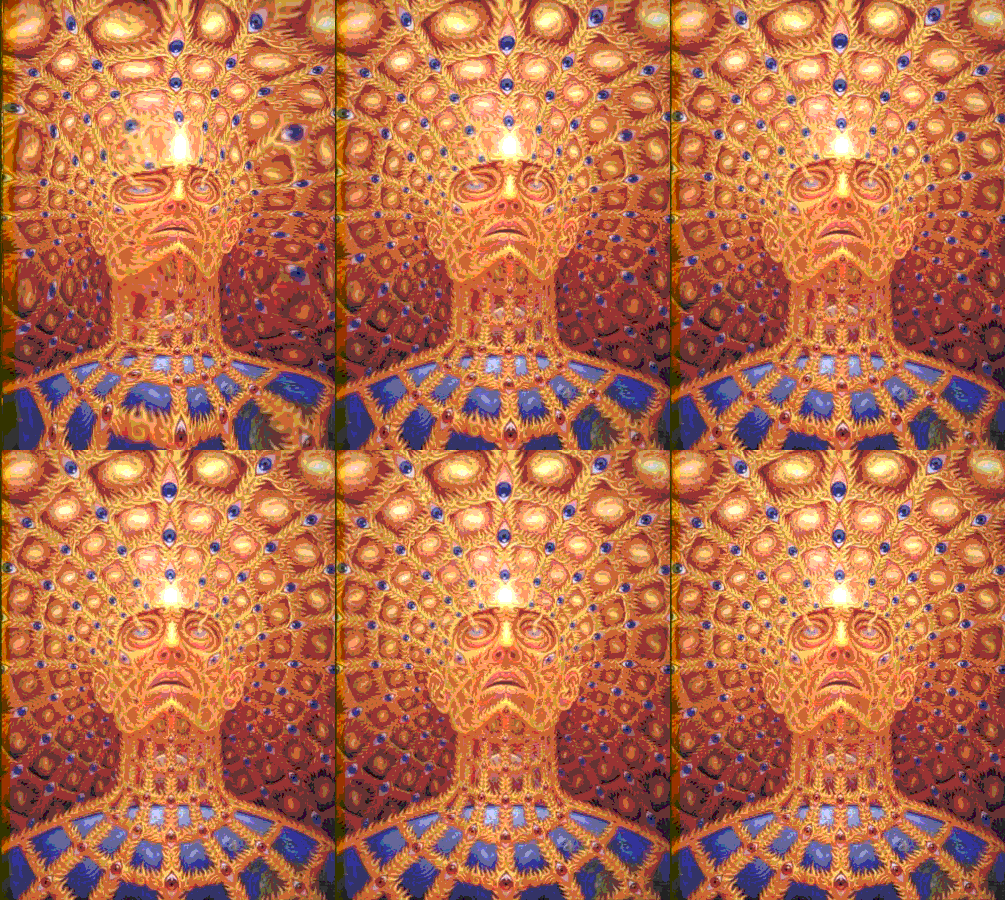
"Definitions of religion tend to suffer from one of two problems: they are either too narrow and exclude many belief systems which most agree are religious, or they are too vague and ambiguous, suggesting that just about any and everything is a religion."
Saying 'cancer' is an umbrella term that connotes some form of auto-immune disorder. Similarly, 'religion' is a catch-all phrase that connotes the dispositions of certain groups of people toward a set of propositions concerning the supernatural. Then again, certain religious people (those who claim a 'religion') are not supernaturalists so much as they are idealists (e.g., some forms of Buddhism are described as atheistic; Mahayanic Buddhism comes to mind). Thus the word 'religion' can run us adrift of helpful understanding.
Some people consider the word 'religion' to be notional. It does not denote anything actual, or real. Jonathan Z. Smith writes in Imagining Religion:
“...while there is a staggering amount of data, phenomena, of human experiences and expressions that might be characterized in one culture or another, by one criterion or another, as religion — there is no data for religion. Religion is solely the creation of the scholar’s study. It is created for the scholar’s analytic purposes by his imaginative acts of comparison and generalization. Religion has no existence apart from the academy.”*
Smith's observation on the classification and definition of religion is keen and helpful. 'Religion' is a blanket term used to quickly, and easily categorize an area of experience and activity obvious in all human cultures. Given Smith's observation, using the term 'religion' at once expresses a common understanding without drawing attention to any one particular faith-claim (e.g., Christianity, Judaism, Islam, Zoroastrianism, Bahá'í, et al.). But for the purposes of conversation, small qualifications are certainly needed. I would do poorly to speak with a Muslim about religion while not clarifying whether I am speaking in the context of his/her religion.
If the term 'religion' is a bit of a chimera made understandable by its attachment to academic generalizations, then whatever definition I give will necessarily enjoy the same attachment. Be that as it may, here is what I understand 'religion' is: the practice of specific, systematized cultural beliefs usually, but not necessarily, attended by the enjoyment of liturgical rites that anticipate communication with the supernatural, and invite an aesthetic experience of transcendence in the believing subject (person).
My definition is practical only in one sense: it finds a place in the academy Smith refered to earlier. Unfortunately, I don't think anyone can adequately define such a term as 'religion' without getting hung up on definitions that are too wide, and therefore fail to regard differences in varying religious claims; or definitions that are too narrow, and therefore inadequately refer to specific faith-claims.
Religion is a cultural motif. It is an on-going narrative that necessarily changes as the cultural climate changes. Some critics would argue that religion should determine culture (e.g., certain Christian academics feel this is an important action for Christians to undertake, and it is certainly a sentiment that runs quite deep within evangelicalism and American right-wing politics). Others argue that religion should be utterly removed from culture altogether by way of science, another blanket term (e.g., Sam Harris). Both positions on the nature of 'religion' in our on-going cultural narratives miss the point altogether: they are interdependent; we cannot force a religionless culture without removing culture and religion altogether. Both our culture and our religions provide an overarching story of our human experiences, aspirations, failures, growths and setbacks, and future history.
'Religion', as difficult a term it is to parse, is, despite its connotative nature, a very useful word that both binds and separates people, intimates a shared understanding, and provides many fascinating hours of stimulating contemplation.
*Smith's quote can be found in this article.
 I'm writing this letter to you to let you know that we can have free discourse here at St. Cynic.
Concerning number 2, it is not only geography that divides us. 6000 kms is quite a long way to go to shake hands and have a drink together -- and it would be well worth it! Nevertheless, my refusal of the Roman communion explicitly divides us, our respective philosophical moorings divide us, and our personalities stand in splendid difference to each other. While you have become more and more entrenched in Catholicism, I have become less and less enthusiastic about organised religion as a whole, and generally cannot abide the superficialities that come from all corners of the Christian marketplace. That last point in mind, however, there are a few people I really enjoy engaging, even to their frustration; you are first amongst them.
 Your militant Catholicism is not offensive to me. I would ask that you extend the same levity toward my place in our conversations. What is offensive to me is some of the doctrines that go before you, and will probably continue on after you're a desaturated memory. A few of those doctrines are The Immaculate Conception, Mary's Assumption, Transubstantiation, Papal Infallibility, and a few others. Since these are doctrines you hold dear, any disagreement I extend toward them will necessarily spur you to defend them. Be that as it may, it would be a fair start to conversation if your first line of defense was not you just don't understand. While that may be true at times, it is not the case every time. I am not committed to Catholicism, so I am free to explore implications as they arise in my mind, even if they're heretical, off-beat, or seemingly disconnected in your mind. That does not render my efforts impotent.
So, in the spirit of Socratic dialogue (open, explorative converstion), let's chase our respective understandings with a respect that chases understanding of each other.
 “The power of accurate observation is commonly called cynicism by those who have not got it.”
 'Belief' is a bit of a dirty word in polite society. 'Knowledge' seems to carry a little more weight. The word 'belief' carries with it connotations of thoughtlessness, credulity, and irrationality. Whereas the word 'knowledge' fosters a sense of confidence, credibility, and accessibility; what one knows, another can get to know. However, what one believes is isolated, and another would have to leap, or make a series of leaps (nonrational, often unverifiable assumptions) to express even a modest association with a claimant's beliefs.
 To 'know' something then, is to suggest that something is incontrovertably what it is, and not something else. To 'know' a thing is to perceive its correspondence to testable, communicable reality. But to 'believe' something is to take on trust what might, at some point, be shown to be false.
 Some clichés are true. I like those ones. Other clichés, thankfully, are not true. For example, the oft-quoted aphorism, "Respect is not given, it's earned." Not true.
 There were sixty of us at the conference. The anticipation wasn't. No-one was visibly excited. Everyone seemed to have dragged themselves through the scree, and into the stiflingly dull meeting hall.
Objectivity is an ideal -- a common one. Unfortunately, it is practically impossible.
All people are subjective, biased, and prejudiced one way or another. We cannot, by dint of existential experience, lay aside personal investment to achieve pure, ultra-cognitive, or suprarational objectivity.
'Objectivity' is necessarily outside human capacity.
Once I had written that down, I was able to recapture my angst and continue feeling unreservedly disinterested in the presentation. Thank you, Philosophy, for rescuing me.
*Please make note that the preceding was an unbiased, even objective look at a subjectively motivated perspective, and does not necessarily reflect the opinions of the writer involved. Naturally. ;)
 I can't read Richard Dawkins's book, The God Delusion. It's just too damned fatuous, and presumptuous. David Berlinski was right: Dawkins is a "crappy philosopher".
 Overall, I'd say I'm a bad Christian.
Here's the laundry list:1. I consistently forget to pray.
2. I seldom read Scripture. Though I really enjoy it when I do.
3. I swear.
4. I am a moody, moody man.
5. I can't pay attention to things that don't interest me.
6. I will take long hiatuses from church and not be bothered by it (last one was 2 years).
7. I commune my kids.
8. Much to the anabaptist's chagrin, I baptise my kids.
9. I can't stand evangelical Jesus-is-my-boyfriend lingo, sentiments, or worship.
10. I refuse to buy in to the latest programmatic/formulaic Christian rubrics for successful conversion of unbelievers.
11. I'm not a pacifist.
12. I read anti-Christian literature, and I don't think Harry Potter will damn me.
13. I watch movies that sometimes have violence or nudity in them.
14. I can't stand most “Christian” music (though I do love Handel and Bach).
15. Politically, I'm libertarian.
16. Philosophically, I'm a Christian anarchist (à la Jacques Ellul).
17. I'm an epistemological agnostic – which is to say that I believe all knowing has a limit as to its origin and scope. After that, I hold fast to “the assurance of things hoped for, and the conviction of things unseen” (Heb. 11:1) in combination with seeing through a glass, darkly (1 Cor. 13:12). So, I hang fast to St. Augustine's dictum, “Crede, ut intelligas” (believe in order that you may understand).
18. I refuse to spank my kids despite all traditional misinterpretations of Proverbs 13:24. Here's why.
19. I don't believe that having a talent, or gift automatically, or ipso facto indentures me to using those talents or gifts in front of the assembly every Sunday morning.
20. I think Sunday School, by-and-large, is a fantastic excuse for absolving yourself of the responsibility of guiding your children into a common, family experience with the holy (there are, admittedly, some rare exceptions).
21. I don't smile because Jesus loves me. I love Jesus and sometimes I smile.
22. I spend a lot of money on organic food. Apparently that makes me unconventional, and financially irresponsible. But if you don't have your health...
23. Sometimes when I pray, I get really sarcastic with God, even angry.
24. I don't think two people necessarily have to have the blessings of the church, and the licence of the government to be married. Though it is a well-reasoned assurance, I think it is mostly an insurance policy. Real marriage, I think, takes place between two people who honestly love each other wholeheartedly, and strive to follow through on life-long commitments to each other. Sex consumates that wholehearted commitment, and thusly signifies two as one.
25. I am a semi-convinced theistic evolutionist.
26. I think homeschooling is the only logical choice for people who really want to develop the depths and riches of what a family really is.
27. I avoid Swiss Chalet on Sunday afternoons because that's where all the Pentecostals are. I eat at Pizza Hut instead because that's where real community happens.
28. I'm not totally into tea 'cause I'm not a teetotaler.
29. Fruit juice during the eucharist doesn't assure me that I'm not going to be an alcoholic, or that I am an alcoholic, or that other people have the same assurance.
30. I like dancing. Sometimes it leads to sex, and I'm okay with that. 'Cause I'm married to the woman I like to dance with.
There must be more to that list, but I really can't think of anything else at the moment. That should be enough to have people mercilessly impugn me, however.
 Ed, at Pilgrim.Not.Wanderer has written an excellent piece on the compulsive nature of prayer. You can find the article here at his site.
Ed's piece reminds me of the words of C.S. Lewis, who, when he was questioned about his prayers to God after his wife, Joy Gresham died, answered "I don't pray because prayer changes God. I pray because it flows out of me; because I need to pray. It doesn't change God; it changes me" (paraphrase from the movie, Shadowlands).
What Ed has described is a compulsivity to prayer. That is, prayer leaps out of us unbounded, joyful, and sometimes mournful, but always free and unfettered, just like the child who can hardly wait to tell his mother or father some exciting tidbit of information -- he can't wait, he just has to interrupt everything else around him to make his voice heard. That is prayer. That is freedom in Christ. That is the enthusiastic impulse of the Holy Spirit in us driving us toward our loving, doting heavenly Father.
Now, though Ed's article was excellently written and very insightful, I did pose one question to him. I needed some clarification on his last sentence, "Cold and calculative prayers are hardly worthy of the name."
So I posted the following comment on his site."But is it worth the discipline? For example, prescribed prayers often help when ex corde moments leave a person without words (e.g., being overwhelmed by an emotional experience and not able to formalize understanding enough to speak
on the experience). In those instances, the calculative nature of a prescribed prayer is valuable -- and definitely worth it -- because prescriptions help verbalise instinctual movements of the heart.
What are your thoughts?
Also, I'm going to link my readership to your article on prayer because I think it is a wonderful piece that touches very tenderly on the intimacy, and compulsive nature of prayer.Thank you for your insights, Ed."
Indeed, Ed. Thank you very much for your warm-hearted understanding on such an important topic.
Artwork via Canadian artist Oliver Ray.


