Showing posts with label Health. Show all posts

Tuesday, December 28, 2010

What Has Not Yet Killed Us

If you recall, I posted that Saint Cynic will be taking on an additional subject: Fitness and Nutrition.  To that end, I have been shoring up some titles of books that I will be borrowing from the local library so that I can read, learn, and inwardly digest.

My purpose behind tackling the field of fitness and nutrition is not to set myself up as any form of authority on the subject; I'm certainly not that.  However, because I was gifted with a modicum of brain-power, and a rational self-interest in my own well-being; because I'm not getting younger and I've frittered away many years of valuable time poking about in areas of interest that have done nothing to stabilize really any area of my life; because I have a swelling interest in improving the quality of my life as a whole; and because I would rather widen the margins for avoiding any possible heritable disorders in my family, I am going to journal my findings as a personal catalogue that others can (hopefully) benefit from.

If nobody besides myself benefits, so be it.  But because I will personally benefit from this new journey then that's one more person who has stepped beyond the pale of faulty "conventional wisdom" and into the light of proper self-actualization, and a more refined sense of actual autonomy.

To begin with, it is true that you are what you eat.  What you take into you, in part, logically comprises aspects of the physical self.  For example, if you habituate yourself to a diet of fast-foods, rancid vegetable oils (which are the oils found in most store-bought food products), and multitudinous forms of sugar then you'll ride out your days on unnecessary insulin spikes that overtax your liver with harmful carbohydrates and result in unhealthy weight gain.  Thus if you eat unhealthy, you will grow into a robust example of ill-health.  What you eat helps determine what you become.

We apply the same principle to how we think ("think positive and you'll be positive", etc.), so why would the same not hold true for your bodily intake?  The simple answer is that it does.  This is incontrovertibly true as borne out by evolutionary history.  And the human body, simply said, cannot adapt to those things that, in effect, weaken it, damage the gene pool, and eventually kill it off.  So, despite Neitzsche's famous quote, "That which does not kill us makes us stronger," it simply does not equal out that poor food intake, while it does not kill you quick enough to pique other's awareness, makes you any stronger, or that our present state of (un)health as a human race will make us any stronger in the future.

The facts are continuing to roll in: we are not dead, but what has not killed us is, in fact, weakening us and, sadly, fattening us up for the eventual slaughter.

With that in mind, I plan to bolster my awareness of proper fitness and nutrition, and change the trajectory of my life overall by improving my understanding of the issues that attend to our culture's declining health.  To begin with, I will be reading Gary Taubes's famous and perrenial volume Good Calories, Bad Calories.

Taubes's credentials are impressive (this blogger has noted them), and he has shaken the dietary world to its core with his über-well-researched essay.  I am looking forward to gleaning everything I can from Taube's work, and then applying his conclusions in their proper directions.

I will offer my reflections on Taubes's work as I go, and hopefully generate some fruitful discussion for everyone involved.  So keep watching Saint Cynic for my reflections on Taubes's book and, of course, for my usual stock-and-trade articles criticising the religio-philosophical world around us.

Thursday, March 18, 2010

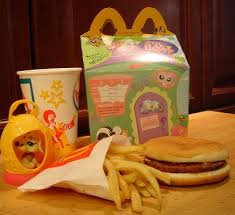
Happy Meal Half-Life

If you leave food on the counter, or somehow exposed, the best predictions would assure us that that food will rot. How long it takes may vary. But the long and the short of exposed food is that it will rot. Simple wisdom.

How complicated things must get then, when that wisdom is confounded by McDonald's Happy Meal. Author Nonna Joann Bruso has been keeping an online journal about the half-life of the Happy Meal. So far, a year has gone by, and the meal has shown no signs of rot, moulding, or decay.

My Conclusion: Food that doesn't break down is not actually food. The infamous Happy Meal may be one of North America's most gleefully recognised packages, but if it defies natural order, it is a paragon of sickness, uselessness, and a plague more than a food. The FDA really ought to have pseudo-foods like this incinerated. Permanently. McDonald's may have the golden arches, but it is inescapably obvious that "all that glitters is not [actually] gold."

*Thanks to the lads at BoingBoing for tipping me off to Bruso's experiment.
*

Sunday, March 7, 2010

Anti-Facebook

I deactivated my Facebook account a couple of weeks ago. The reason: I find it to be an inexcusable waste of time. When I mentioned deactivating my account with Facebook to a friend of mine, he said, "Good! I was going to tell you to get off that thing. It's addictive. It's like crack cocaine. Besides that, you were being too conformist being on there."

Aside from the wry chuckle I enjoyed at his comments, I found his perspective on Facebook insightful: it's addictive, and it promotes conformity.

First, let's look at some behavioural characteristics of addiction.
  1. Obsession - person cannot stop thinking about an activity.
  2. Relentless Pursuit - person will engage in activity even to the detriment of his/her physical and psycho-social well being.
  3. Compulsiveness - person will engage in an activity despite not wanting to, and finds it difficult to stop.
  4. Withdrawal - once the addictive activity is stopped, person becomes irrational, irritable, depressed, restless.
  5. Lack of Perception of Time - person cannot control how long, when, or how much s/he will engage in an activity.
  6. Denial - person cannot, and will not accept that s/he has an irrational attachment to an activity, even despite the negative effects.
  7. Covert-Ops - person hides his/her activity from friends, family, and concerned individuals.
  8. Blackouts - person simply blanks-out during activity, which results in a lack of recall about what went on during addictive activity.
  9. Depression - person experiences depressed states surrounding, and even during activity.
  10. Poor Self-Esteem - person deals with personal anxieties and low self-esteem issues by "filling in their lack", as it were, with an addictive activity.

As a loose gauge for my own participation with Facebook, this list shows me that I fit at least 7, possibly 8 of the characteristics usually associated with addictive behaviours. As a family man, and a man with a conscience, I find that unacceptable. So, for this reason alone, I shut down Facebook.

Now, just so we're clear, I am not blaming Facebook for my problems. I am solely responsible for how I attend to an activity, how much time I spend doing it, and in what manner. Facebook itself is simply a computer application and has nothing to do with my addiction to it. But, as a vehicle for part of my social life, I cannot trust myself to use Facebook anymore because I was not able to control myself around it. Also, because I was allowing my time on Facebook to interfere with my family, my real-life relationships were starting to break down. So, for me, having parrotted the common sentiment that I would "take a bullet" for my family if I had to, why would I allow myself to shoot my loved one's down with an inordinate compulsion toward Facebook?

The answer to the rhetorical question above is an easy, "I wouldn't." But I did. And I did so unintentionally, and to my shame. But even unintentionally having hurt my family because of my own addictive behaviours surrounding Facebook, the result is the same: my family was hurt. Intentionality does not exhonerate me from the pain my family has felt this past while. My work is ahead of me; I have a lot of wounds to heal.

Coming at this from a different, more 'academic' angle, however, there is a certain conformity proffered in applications like Facebook, MySpace, Twitter, et al. That is, applications such as the ones listed dole-up a common denominator people can easily access and use. The fact that applications like these offer the same basic templates for social interaction, aesthetics, and mindless pursuits (e.g., Farmville) now strikes me as a little creepy. I don't ascribe anything apocalyptic to it, but the fact that there is a definite sense of sameness across the board comes across a little Hux-Wellian.


Facebook is a little like a prototype for the 'Feelies' so excellently imagined in Huxley's Brave New World: slip into a virtual reality where everything surrounding you is a template for homogeneity, and predictability. The best part about it is that you don't actually have to carry on a real relationship with a real person. You can simply 'Add' and 'Delete' on a whim, and at will.

At the same time, Facebook is also a little like Big Brother. Mind you, the government is not prescribing Facebook as a means of mass-control, so the comparison is very loose. Still, people are screened for jobs by employers looking up Facebook accounts. Corporations actively monitor people's use of Facebook to keep an eye on the corporate reputation. Facebook does not protect your privacy, but instead, allows your information to be readily accessible to marketters (data-mining), industries, government, etc. It is a wonderful vehicle for corporate voyeurism (ever wonder why your stuff is hyperlinked without you having hyperlinked your information?). It is not quite Big Brother, but it is like having Big Brothers.

Facebook promotes uniformity not in people's ontology, but in people's expressions. That is, you don't stop being who you are by using Facebook, but you begin to alter how you express yourself to fit the mold offered. Eventually, this will impact who a person is. The same principle is illustrated in a positive light in the movie Patch Adams: if you change the conditions, or parameters of a persons environment, you affect their response. This in turn affects who the person is on a fundamental level. Seeing as Facebook is generally a breeding ground for poor grammar, thoughtless banter, useless games and quizzes, ambivalent attachments, and techonological distancing (i.e., moral ambivalence via technology), it shouldn't come as a surprise when people start communicating in real life as they do on Facebook. I imagine conversations would sound like Valspeak, but less eloquent.

I refuse that measure of conformity. I refuse that common denominator, which, as I see it, will continue to get lower and lower as the phenomenon of social-networking applications trim out the fat of human-to-human contact, and unwittingly inject us with the narcotics of virtual reality, and pseudo-relationships. I will not follow suit any longer. I am officially anti-Facebook.

Sunday, October 5, 2008

Breaking Wind, er, News

Wind turbines are growing in popularity as an alternative source of eco-friendly energy. The problem is that people who prop-up wind turbines beside their houses are finding out that, yes, they're eco-friendly, but not people-friendly.

In fact, wind turbines have earned themselves the dubious honour of being a new health problem. It's called Wind Turbine Syndrome, and it's generating a host of medical problems for pockets of the world's populations.


Would it be rude of me to say that this news blew me away?