Showing posts with label Prayer. Show all posts

Monday, June 21, 2010

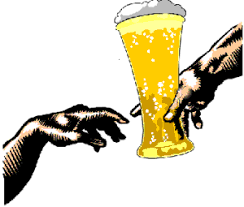
Work, Pray, and Lager

On one of the chat-boards I participate on, a member was concerned that his job was in danger. The situation is simply that his two bosses -- one an evangelical Christian, the other an orthodox Jew -- were requiring that each work-day start in prayer. To add, the employees were informed that they would be required to lead prayer.

Being as the concerned board-member is an atheist, he wanted to seek out advice for how to handle the situation.

The most creative response so far has been the following:
Recite this prayer:

"Our lager, Which art in barrels, Hallowed be thy drink. Thy will be drunk, I will be drunk, At home as it is in the tavern. Give us this day our foamy head, And forgive us our spillages, As we forgive those who spill against us. And lead us not to incarceration, But deliver us from hangovers. For thine is the beer, The bitter, The lager.

Ramen."
My abdomen now hurts from laughing too hard.

What would you suggest this atheist do?

Tuesday, July 28, 2009

Can't See Reality for the Spiritual

Christians sometimes pray for God to make something come about in their lives that they are completely capable of bringing about themselves (e.g., gaining muscle mass, losing weight, quitting smoking, finding a first-rank parking spot, etc. and ad naseum).

It's an attitude of neglect, I personally think. I think people speak those kinds of prayers because they have a confusion that salvation offers a special 'spiritual entitlement'; one that is removed from the normal strictures of real life. It's almost as if Christian belief in the salvation offered by Christ, once accepted, must mean we can mine God for all our desires now because why wouldn't He want to operate in a fundamentally different alignment to reality? Especially when it comes to 'me' -- whoever 'me' is, and whatever psychological parameters that go into such a histrionic mindset.

Perhaps my view is cynical. Even if it is, it also reflects a sadness I feel when in the company of Christians who think in such ways. I do have to wonder what sorts of things s/he has been taught about God, the ways He empowers us -- most specifically, and wonderfully in the imago dei -- and what our real responsibilities are as stewards of creation. Why create us in His image, give us incredible attributes, skills, and abilities just so we can pawn off our responsibility to use these gifts in the vague and unfounded hope that God will do it for us anyway? I mean, really, when you weigh the cost of having to apply yourself against all the common barriers of life, why not let God step in and veto your chances to strive? It's certainly cheaper to let an omnipotent being do something for you than to have to make an effort on your own, hey?

I do feel sad that, on this point, Christians seem to miss reality for the spiritual. The maxim "can't see the forest for the trees" comes to mind. That causes me to wonder that if reality encompasses spirituality, then why is the spiritual life of the Christian suddenly the overlapping reality? At what point can we get away with the (ill)logic that the part (spirituality) is greater than, or somehow definitionally more important than the whole (reality)? And then why do we feel somehow entitled when we need something from the whole of reality, but only go to part of reality to suss things out?

I just don't understand this particular line of (un)thinking.

Friday, May 8, 2009

Prayer: Letters Chiefly From Ed

Ed, at Pilgrim.Not.Wanderer has written an excellent piece on the compulsive nature of prayer.  You can find the article here at his site.

Ed's piece reminds me of the words of C.S. Lewis, who, when he was questioned about his prayers to God after his wife, Joy Gresham died, answered "I don't pray because prayer changes God. I pray because it flows out of me; because I need to pray. It doesn't change God; it changes me" (paraphrase from the movie, Shadowlands).

What Ed has described is a compulsivity to prayer. That is, prayer leaps out of us unbounded, joyful, and sometimes mournful, but always free and unfettered, just like the child who can hardly wait to tell his mother or father some exciting tidbit of information -- he can't wait, he just has to interrupt everything else around him to make his voice heard. That is prayer. That is freedom in Christ. That is the enthusiastic impulse of the Holy Spirit in us driving us toward our loving, doting heavenly Father.

Now, though Ed's article was excellently written and very insightful, I did pose one question to him. I needed some clarification on his last sentence, "
Cold and calculative prayers are hardly worthy of the name."

So I posted the following comment on his site.

"But is it worth the discipline? For example, prescribed prayers often help when ex corde moments leave a person without words (e.g., being overwhelmed by an emotional experience and not able to formalize understanding enough to speak
on the experience). In those instances, the calculative nature of a prescribed prayer is valuable -- and definitely worth it -- because prescriptions help verbalise instinctual movements of the heart.

What are your thoughts?

Also, I'm going to link my readership to your article on prayer because I think it is a wonderful piece that touches very tenderly on the intimacy, and compulsive nature of prayer.
Thank you for your insights, Ed." 

Indeed, Ed. Thank you very much for your warm-hearted understanding on such an important topic.

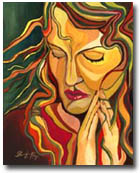
Artwork via Canadian artist Oliver Ray.

Saturday, September 27, 2008

The Law of Prayer

Rev. Rick Stuckwisch has a very insightful article, here, on the maxim lex orandi, lex credendi (the law of prayer is the law of believing).
"That is, the way (and the what) that one prays is intimately and reciprocally related to the way (and the what) that one believes."

It is a simple fact that "out of the overflow of the heart the mouth speaks" (Matt. 12:34; Lk. 6:45). And it is reasonable to extrapolate from that that our understanding of our Christian faith will come out in prayer.

This, if anything, should give us impetus to "go into your room, close the door and pray to your Father, who is unseen" (Matt. 6:6). For it is there, in your room, in prayer, that your real education will begin (Dostoevsky, Have Mercy On Those Who Come Before Thee). It is there that what you believe will be meted out under the beneficient guidance of the Holy Spirit. It is there that you will "continue to work out your salvation with fear and trembling" (Phil. 2:12). It is there that the soul stands taller when the body is on its knees.

If the 'law of prayer is the law of believing', then what an amazing opportunity we have to step into the Holy of Holies and ask God what it is we should believe, how we should go about practicing it, and how we can articulate it in ways that help others (1 Pt. 3:15-16)! If what is prayed is what is believed then each of us has a duty to listen that much more closely to the prayers of our brothers and sisters so that we can learn from their life with God, and gently correct if what they pray is not what they practice. At the same time, we are wise to receive admonitions from our brothers and sisters if what they hear us praying is not what they see us practicing.

So what is it that we can be confident about believing? There has to be some baseline, some suppositional starting point where we throw ourselves into the mix and try and figure out what is right to believe. And the primary answer to that is, the Word of God.

Our prayers should be steeped in the Word of God, drawing on His words to inform our hearts, minds, and bodies. We are to let the Word of God indwell us, take up home in us, live in us (Col. 3:16-17), and by doing so, "whatever [we] do, whether in word or deed, do it all in the name of the Lord Jesus, giving thanks to God the Father through Him."

It is a linear application: the Word of God prompts its own expectations. That is, because the Word of God is living and active (Heb. 4:12), and indwells the believer, it urges what it teaches; it spurs the believer on to what it declares. In that sense,

"...doctrine informs practice, but practice in turn shapes doctrine. What the church does, and how she does it, not only confesses but in time also determines what she believes and teaches. The practice of prayer is a way of teaching; indeed, it is a primary means of catechesis, which forms thinking and believing."

The living Word of God that indwells each Christian is the baseline for all Christian belief. What God has said, we believe; what we believe should be what we practice. Hence there is a direct correlation between what a Christian prays who has the living Word of God indwelling him, and what he practices. And what should the Christian practice? Matthew 25:31-46 and James 1:27 give clear, though not exhaustive answers to that question.

The secondary answer to what is right to believe comes down to us through the "democracy of the dead" (G.K. Chesterton). That is, through the creeds (Apostle's, Nicene, and Athanasian) and traditions of believers who have gone before us. The creeds (from the Latin credo, "I believe") summarize the heart of the Christian faith by placing the chief doctrines of Scripture in brief.

Looking to the freedom of the saints of the past points us to the freedom we can enjoy in Christ both now, and in the future. Their exemplary lives serve as a constant guide for how 'the law of prayer is the law of belief' by highlighting the intersection between what they believed and how they practiced it.

We do well to heighten our attention to our prayer lives. Prayer is our umbilical chord to God. It is how we are fed, because in prayer God reinforces His Word so that it indwells us. From there, what we pray forms what we believe, and what we believe becomes our practice. Rev. Stuckwisch can have the last word on this subject:

"So we are rightly concerned with "prayer," broadly speaking, as a teaching and confessing of belief. Right praying serves, supports and substantiates right believing, in much the same way that heterodox praying is both indicative and precipitant of heterodox believing. That's basically the affirmation and the warning implicit in "lex orandi, lex credendi," as it is typically summoned to duty."