I ended up with a song stuck in my head for most of the day, today. I thought I'd share it with you. Enjoy!
An oldie, but a goodie!
Wednesday, March 16, 2011

Review: The Atheist's Way

Where Maisel's book differs from the spate of recent atheist literature (e.g., Hitchens, Dennett, Dawkins, Harris, et al) is in his focus: where a thick brace of literature has been dedicated to showing the poverty of the religious life, Maisel has written to draw attention to the richness, beauty, and meaningfulness of the non-religious life. Hitchens writes to highlight the toxicity of religious thinking; Maisel writes to encourage meaning-making in the atheist's approach. Dennett writes to convince the reader that religion is a mental spell, a collective notion that gods influence nature therefore we worship them; Maisel writes to spur the religious into letting go of their assumptions of beneficient gods and face an indifferent universe open to innumerable possibilities for self-actualisation. Dawkins writes to dispell delusions and rationalisations about the supernatural; Maisel writes to reassure the disbelieving that making your meaning is better than adopting an already prescribed religious meaning. Harris writes to discourage adherence to any religious systems, and to shun the moderates for their cowardly, yet inadvertant support of extremists; Maisel writes to enliven a sense of life in the irreligious, and to move on bravely toward a whole sense of selfhood--a quality he suggests cannot be had in the religious life.
I'm sure you already see that Maisel is taking a positive approach to an often overly negative subject: disbelief. And by negative, I don't mean to say that authors like Hitchens and Dawkins are a bad influence, or inappropriately dark and cynical. They're not. Still, Maisel has gone in a direction the so-called New Atheists have not: rather than tearing down gods, God, and the religions that attest to gods and God, he has taken the opportunity to outline the positive side of disbelief.
 |
| Super-Christian |
Instead, the disbeliever chooses what he values, recognises the ultimate subjectivity of participation in life, and makes his own meaning. This bears some similarity to Ayn Rand's stance on selfishness: people always act in such a way as to keep what they value; they are therefore "selfish" or self-interested. The man who values personal freedom acts in such a way as to keep his freedom; he develops the virtue of productivity. He does not allow others to hand him the value of freedom because it was never anyone else's to give to him in the first place. And the mentality that suggests meaning needs to be earned by other's approval or permissions is the very same mentality that is on display in religion: your values, your meaning, your personal actualisation is imposed on you by an already established system, and that system gives approval or not to your worth.
The evidence for this is ample. Consider, for example, the Catholic teaching that the use of condoms is immoral. This article suggests that the Catholic laity is in disagreement with the current pope about the immorality of condoms; but does that change anything? It might in private practice, but in public religious life, a lot of these same Catholics who disagree with their pope will still buckle under his imposed ruling: condoms should not be used (spare, of course, if your are interested in the propositions of male prostitutes infected with AIDS). More, those Catholics who do sheathe their swords, as it were, will struggle uselessly (and infuriatingly, if you ask me) with guilt and shame for their choice to shag in latex. They may even go so far as to confess their wicked deed, feel better, then repeat their "sin" and be told, after multiple confessions that their values are disorderly, not in line with the teachings of the church, or that their salvation is in danger because of habitual mortal sin.
The example above illustrates rather graphically that the struggling Catholic condomite is deriving his value from the teachings and constructed meanings of his chosen church. Maisel, if I have understood him right, would suggest that that Catholic individual is allowing some of his meaning to be chosen for him, instead of making his own meaning. Sadly, billions of people allow themselves to be bullied by clergy that tells them they have to seek their meaning in the teachings of the church, rather than make their meaning by the act of choosing and self-actualising on their own terms, and with their own resources.
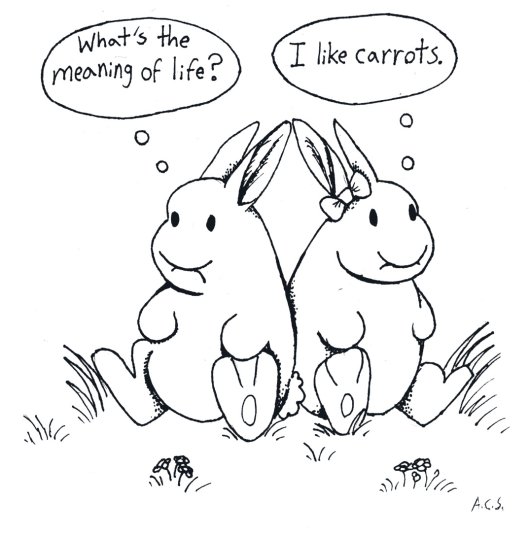
You don't have to "find" meaning. You have to make meaning. In other words, you have to invest yourself into your own passions, your own interests, your own wants, and then you have to do what only you can do--because you're the only one who is you--to achieve your passions, maintain your interests, and gain what you want. You have to choose your values, not piggy-back the values of others or use stand-in values such as those enforced by religions. Maisel, in fact, goes so far as to state that religion itself is a stand-in for meaning; that is, religion takes the rightful place of personal meaning by imposing itself as over above self-chosen meaning.
Maisel's writing is clear, gentle, and inviting. That last qualifier, however, sometimes serves to be a detractor from his efforts, as if by writing in an inviting style he is luring or tempting the reader to try on the religionless life. I don't think I'd mind that so much if it weren't for the fact that I appreciate much more the blunt approach of Harris or Hitchens when it comes to addressing the moral necessity for atheism. I'm not appreciative of saccharine, or glad-handed tones regarding major life decisions. As minor a criticism as that is, I think Maisel's book adds a much needed, and excellent view of the areligious life, and how to self-actualise even after the experience of deconversion and the confusions such a switch can make.
Sunday, March 13, 2011
Nicely Stated
 |
| Paul Cooijmans |
Love it!
Shame and Catholicism: Bedmates
| Denial, shame: Catholic. |
First, read this (it's not long, and is quite interesting).
Second, my response to the article linked above:
I personally think that the Catholic heirarchy, were they allowed to legitimately indulge their sexual desires, would have a very different view of sexual intimacy. I really don't hear tale of the Eastern Orthodox church having sexual scandals or legalisms surrounding sexual pleasure between consenting couples. Their priests are allowed to get married, and allowed to enjoy the benefits that confers.
In Catholic quarters, their psycho-social and sexual development is stunted by the blunt force of useless prohibitions on sexual exploration between couples, masturbation, and other harmless hedonisms. Predictably, some Catholic clergy therefore have unacceptable deviances, and Catholic couples are demeaned and disempowered by imposed guilts and harmful preachments about how they should use their body (bawdy!) parts.
I find it a supremely interesting observation that Catholicism stands against legalisms in devotional life (i.e., the notion that one can effect favour with God through efforts at purity) but sets in place a massive legalistic social framework for its adherents (e.g., Canon Law). Is it any wonder that people feel horrible when they come to the instinctual understanding that their devotion to God has resulted in a shame-based identity with their church? This confusion around sexually acceptable practice is one among many, many, many crimes against sanity.
What are your thoughts about this issue?
Saturday, March 12, 2011
Rot and Stink
 "In a criminal society, goodness is a crime. We have no moral obligation to tell the truth to the devil. To do so is likely to be actually immoral." --Dee
I was in a conversation with a well-spoken activist--at least, that's what I'll label him for the purpose of ease--and we were enjoying an exchange about the principles of anarchy (see quote above). For example, anarchic philosophy calls for non-violence; anarchic philosophy emphasizes the sovereignty of the individual over above the collective; the responsibility of the individual is to provide for his own needs by the work of his own mind and hands, not by leeching off of the handouts of infrastructure when he is capable of doing otherwise.
However, our current socio-political climate does not allow for non-violence. Consider our nation's involvement in wars that have nothing to do with us (e.g., Iraq). Consider, also, that in Canada each person is in a holding pattern so far down in the lattice-work of control that considering yourself a 'sovereign' (solely over your own life, mind, and no-one else's) comes across as "eccentric" or "idiotic" or "crazy." Or, consider that taxes are enforced: you earn your living, your country takes money from you it didn't earned, puts it towards ends you may not support, and then threatens you with fines and possibly jail-time if you don't give over a portion of your money. This last example has the same rot and stink about it that the medieval church's enforced tithing did.
Whether or not I agree with these principles, I was given pause to think about who I am in contrast to the larger collective (society), and what the nature of our present collective is: are we living in an actual democracy? Is democracy defined simply by being able to vote at elections? Or is there something more to it that isn't being effected in Canadian culture? If I were to consider myself a sovereign, how would that effect my participation in the common-place infrastructure of society? Is it "criminal" to not give your money to a bigger group of people (the government) when they haven't earned it, and simply because they declare it criminal to not give money to them? Should the government be re-labeled Big Vinny, and considered a sophisticated leg-breaker?
I don't know. At the very least, I was forced to think of some very interesting alternate points of view. And, being the curious person that I am, I appreciated the mental exercise said activist gave me.
Sunday, March 6, 2011
Recommendation: A Place Called Freedom
 Ken Follett, author of international best-sellers The Pillars of the Earth (also a TV mini-series) and World Without End has stormed into my mind and heart with his totally enthralling, relentlessly visceral yet beautiful story A Place Called Freedom.
It is the story of a coal-miner, Malachi McAsh--affectionately known as 'Mack'--who wants nothing more than his freedom, his definition and right as a dignified human being. His slave-masters, the Jamisson's, however, consider him a dangerous upstart, and set themselves against Mack and his desire for freedom. Mack is eventually sentenced to death but, by a fortuitous twist, is shipped to America. Once there though, he continues to fight for the only thing he's ever wanted: freedom.
I cannot heap enough praise on this book. If you have enough room in your life to fill it with 437 pages of intense and gorgeous story-telling, you will not go wrong reading this book. It is, quite simply, one of the best fictions I have ever read.
Ken Follett gets the Saint Cynic Award of Awesomeness, and in spades!

I can't wait to read Follett's other two novels I listed! But first, The Fountainhead.
Friday, March 4, 2011

Subscribe to:
Posts (Atom)